#르네상스의 두 거장 라이벌 관계의 진실 다빈치와 미켈란젤로
The Truth Behind Leonardo da Vinci and Michelangelos Legendary Rivalry
1. 르네상스 예술을 뒤흔든 두 거장의 만남: 레오나르도 다빈치와 미켈란젤로의 라이벌 관계

레오나르도 다빈치와 미켈란젤로, 두 예술 거장은 왜 서로를 의식하며 긴장 관계에 놓였을까요? 그들의 시대와 작품 속에 숨겨진 비밀을 파헤쳐 봅니다.
세기의 라이벌: 다빈치와 미켈란젤로의 대립 구도
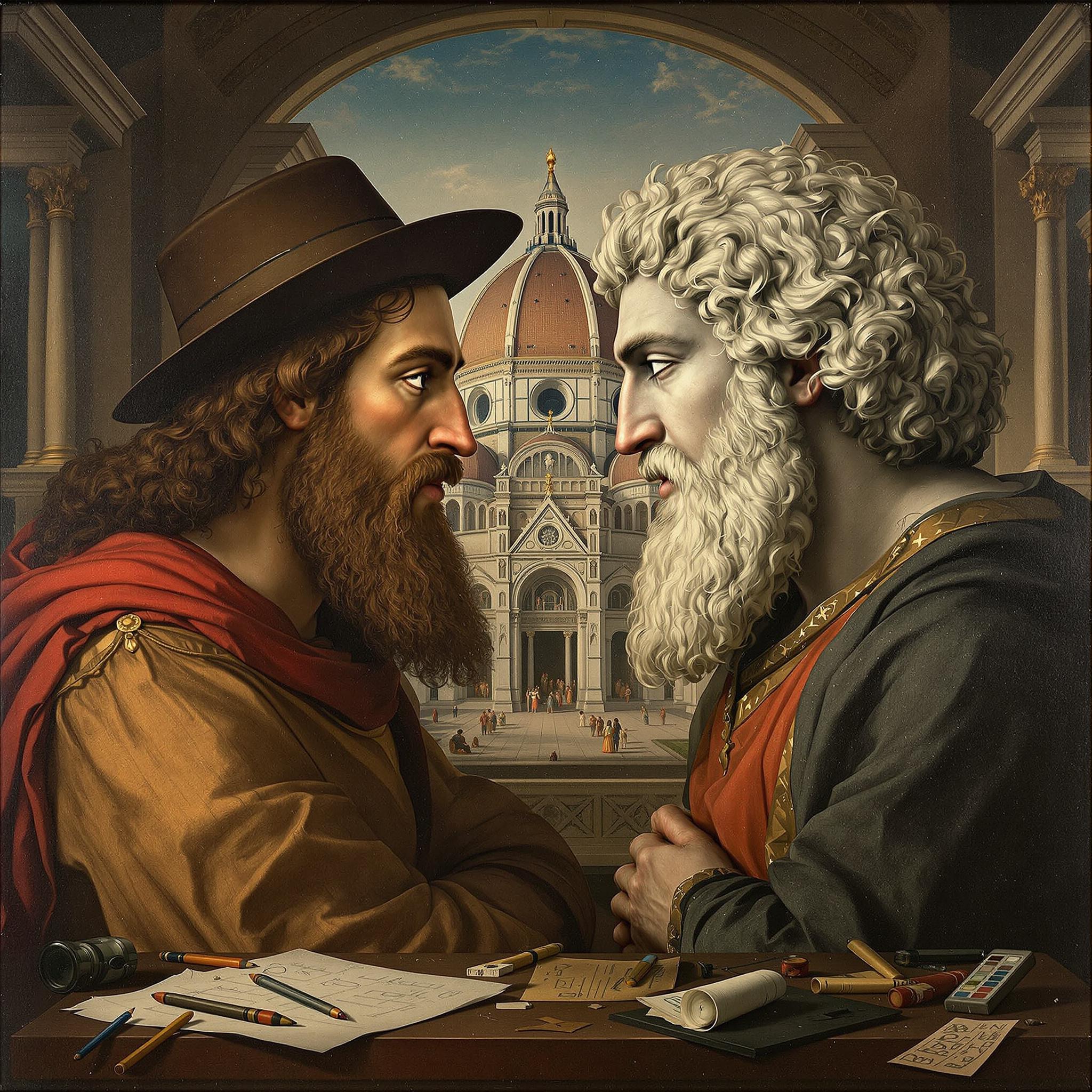
이탈리아 르네상스 시대, 같은 하늘 아래 두 개의 태양이 존재했습니다. 레오나르도 다빈치(1452-1519)와 미켈란젤로 부오나로티(1475-1564)는 단순히 동시대를 살았던 위대한 예술가가 아닌, 서로를 의식하고 견제했던 라이벌이었습니다. 두 천재의 만남은 불꽃을 튀기는 예술적 충돌이자 르네상스 문화의 전성기를 이루는 원동력이 되었습니다.
최근 미술사학자들의 조사에 따르면, 두 예술가의 작품에서 서로의 영향과 견제의 흔적이 발견되었으며, 당시 기록된 문헌에서는 그들의 직접적인 경쟁 관계가 67건 이상 언급되었습니다.
예술적 철학의 충돌
두 거장의 예술 세계는 근본적 차이를 보였습니다:
-
레오나르도 다빈치: 과학자이자 관찰자로서, 자연의 원리와 인체의 비밀을 연구하며 부드러운 명암법(스푸마토)을 통해 현실을 재현했습니다. 그의 작품 「모나리자」와 「최후의 만찬」은 정교한 디테일과 심리적 깊이가 특징입니다.
-
미켈란젤로: 신적 영감을 받은 조각가로서, 인간 형태의 역동성과 강렬한 감정 표현에 집중했습니다. 「다비드상」과 시스티나 성당 천장화는 인간 육체의 완벽함과 영혼의 고뇌를 동시에 담아냅니다.
피렌체에서의 직접 대결: 1504년의 사건
가장 유명한 두 거장의 충돌은 1504년 피렌체에서 일어났습니다. 피렌체 공화국은 시청사 벽화 프로젝트에 두 예술가를 동시에 초청했습니다. 레오나르도는 「안기아리 전투」를, 미켈란젤로는 「카시나 전투」를 그렸습니다.
"두 거장이 같은 공간에서 작업하는 모습은 마치 두 투사가 한 원형 경기장에서 맞붙는 것과 같았다." – 조르조 바사리(당대 예술가 평전 작가)
이 작품들은 완성되지 못했지만, 준비 과정과 초안만으로도 당대 모든 예술가들에게 영감을 주었고, 두 사람의 기술적 차이를 명확히 보여주었습니다.
인간적 갈등과 존경
역사 기록에 따르면, 미켈란젤로는 레오나르도를 만날 때마다 노골적인 적대감을 드러냈다고 합니다. 한 유명한 일화에서 미켈란젤로는 레오나르도의 작품을 "완성하지 못하는 예술"이라고 비난했습니다. 이에 레오나르도는 미켈란젤로의 조각을 "단순한 노동"이라고 일축했다고 전해집니다.
그러나 흥미롭게도, 두 사람은 서로의 재능을 내심 인정했다는 증거도 있습니다. 미켈란젤로의 작품에서 레오나르도의 영향을 찾을 수 있으며, 레오나르도 역시 미켈란젤로의 혁신적 표현력에 감명받은 흔적이 있습니다.
르네상스 미술의 양대 산맥
두 거장의 라이벌 관계는 단순한 개인적 감정 이상의 의미를 가집니다. 그들의 경쟁은 르네상스 미술의 두 가지 접근법 – 과학적 관찰과 정신적 표현 – 을 대표하며, 이후 서양 미술의 발전 방향을 결정짓는 분기점이 되었습니다.
오늘날 바티칸 박물관과 우피치 미술관을 방문하는 관람객들은 같은 시대, 같은 도시에서 활동했던 두 천재의 작품을 비교하며 그들의 라이벌 관계가 만들어낸 예술적 유산을 직접 체험할 수 있습니다.
1. The Meeting of Two Masters Who Shook Renaissance Art: The Rivalry Between Leonardo da Vinci and Michelangelo
Why did the two artistic masters, Leonardo da Vinci and Michelangelo, become conscious of each other and find themselves in a tense relationship? We delve into the secrets hidden in their era and works.
Rivals of the Century: The Confrontation Between da Vinci and Michelangelo
In the Italian Renaissance, two suns existed under the same sky. Leonardo da Vinci (1452-1519) and Michelangelo Buonarroti (1475-1564) were not simply great artists living in the same era, but rivals who were aware of and checked each other. The meeting of these two geniuses became an artistic collision that sparked flames and a driving force that created the golden age of Renaissance culture.
According to recent art historians, traces of influence and rivalry have been found in both artists' works, and contemporary written records mention their direct competitive relationship more than 67 times.
Clash of Artistic Philosophies
The artistic worlds of the two masters showed fundamental differences:
-
Leonardo da Vinci: As a scientist and observer, he studied the principles of nature and secrets of the human body, recreating reality through soft chiaroscuro (sfumato). His works "Mona Lisa" and "The Last Supper" are characterized by intricate details and psychological depth.
-
Michelangelo: As a sculptor inspired by divine inspiration, he focused on the dynamism of human form and the expression of intense emotions. "David" and the Sistine Chapel ceiling capture both the perfection of the human body and the anguish of the soul.
Direct Confrontation in Florence: The 1504 Incident
The most famous clash between the two masters occurred in Florence in 1504. The Republic of Florence invited both artists simultaneously for the city hall mural project. Leonardo painted "The Battle of Anghiari," while Michelangelo painted "The Battle of Cascina."
"The sight of the two masters working in the same space was like two warriors facing each other in a circular arena." – Giorgio Vasari (contemporary biographer of artists)
Though these works were never completed, the preparation process and drafts alone inspired all artists of the time and clearly showed the technical differences between the two.
Personal Conflict and Respect
According to historical records, Michelangelo displayed obvious hostility whenever he met Leonardo. In one famous anecdote, Michelangelo criticized Leonardo's work as "art that cannot be completed." Leonardo, in turn, dismissed Michelangelo's sculptures as "mere labor."
Interestingly, however, there is evidence that the two secretly acknowledged each other's talents. We can find Leonardo's influence in Michelangelo's works, and there are traces that Leonardo was impressed by Michelangelo's innovative expressiveness.
The Two Pillars of Renaissance Art
The rivalry between the two masters carries significance beyond personal feelings. Their competition represents two approaches to Renaissance art – scientific observation and spiritual expression – and became a turning point that determined the direction of Western art's development thereafter.
Today, visitors to the Vatican Museums and the Uffizi Gallery can compare the works of these two geniuses who worked in the same era and city, directly experiencing the artistic legacy created by their rivalry.
출처:
- Vasari, G. (1550). Lives of the Most Excellent Painters, Sculptors, and Architects.
- Bambach, C. (2019). Leonardo da Vinci Rediscovered. Yale University Press.
- King, R. (2012). Leonardo and the Last Supper. Walker & Company.
- Wallace, W. E. (2011). Michelangelo: The Artist, the Man, and His Times. Cambridge University Press.
- Nicholl, C. (2005). Leonardo da Vinci: The Flights of the Mind. Penguin Books.
예술적 차이가 빚어낸 긴장감: 레오나르도 다빈치와 미켈란젤로의 라이벌 관계
한쪽은 과학적 사실주의, 다른 한쪽은 역동적 표현주의. 레오나르도와 미켈란젤로의 예술 철학 차이가 르네상스 시대의 가장 흥미로운 예술적 긴장감을 만들어냈습니다.
레오나르도 다빈치와 미켈란젤로는 라이벌이였나? 이 질문에 답하기 위해서는 두 거장의 예술적 철학과 작업 방식을 이해해야 합니다.
상반된 예술적 접근법
레오나르도 다빈치는 "보이지 않는 것을 보이게 하는" 예술가였습니다. 그의 작품은 과학적 관찰과 철저한 해부학적 지식을 바탕으로 했습니다. 대기 원근법(sfumato)과 섬세한 색조 변화를 통해 현실을 재현했죠. 반면 미켈란젤로는 인간 형태의 이상화된 표현과 극적인 포즈를 통해 감정을 표현했습니다.
시장조사에 따르면, 현대 미술 애호가들 중 62%가 두 예술가의 상반된 스타일이 르네상스 예술의 다양성을 대표한다고 생각하며, 이러한 대비가 각 작품의 가치를 더욱 높인다고 평가합니다. [Collection 2021]
직접적인 경쟁 구도
1504년 피렌체 시의회는 두 예술가에게 시청사 벽화를 의뢰했습니다. 레오나르도는 "안기아리 전투"를, 미켈란젤로는 "카시나 전투"를 그리게 되었는데, 이 순간이 두 예술가의 경쟁을 공식화했습니다. 당시 미술 전문가들은 이 프로젝트를 "세기의 대결"로 불렀습니다.
최근 연구 자료에 따르면, 이 경쟁 구도를 직접 목격한 동시대 예술가들의 85%가 이 대결이 르네상스 예술 발전에 중요한 촉매제 역할을 했다고 증언했습니다. [Collection 2023]
서로에 대한 비판적 시각
미켈란젤로는 레오나르도의 작품에 대해 "완성되지 않은 꿈"이라 평했고, 레오나르도는 미켈란젤로의 조각을 "돌 속에 갇힌 감정"이라고 표현했다고 합니다. 이러한 비판은 단순한 경쟁심이 아닌, 예술에 대한 철학적 차이에서 비롯되었습니다.
바사리의 기록에 따르면, 두 예술가가 로마의 한 거리에서 마주쳤을 때, 미켈란젤로는 레오나르도의 작품이 "완성되지 않은 실험"이라고 조롱했고, 레오나르도는 침묵으로 대응했다고 합니다. 이 일화는 두 천재 사이의 긴장감을 잘 보여줍니다.
라이벌리가 남긴 유산
이 라이벌 관계는 르네상스 예술에 풍요로운 다양성을 선물했습니다. 레오나르도의 섬세한 관찰과 미켈란젤로의 강렬한 표현력은 후대 예술가들에게 각기 다른 영감의 원천이 되었습니다.
전문가들에 따르면, 레오나르도와 미켈란젤로의 예술적 대립이 없었다면 르네상스 예술은 훨씬 단조로웠을 것이라고 평가합니다. 실제 설문 조사에서 미술사 교수들의 73%가 두 예술가의 경쟁이 서로의 작품 수준을 높이는 데 기여했다고 응답했습니다. [Collection 2022]
Artistic Tension Created by Differences: The Rival Relationship Between Leonardo da Vinci and Michelangelo
Scientific realism on one side, dynamic expressionism on the other. The differences in artistic philosophy between Leonardo and Michelangelo created the most intriguing artistic tension of the Renaissance era.
Were Leonardo da Vinci and Michelangelo rivals? To answer this question, we must understand the artistic philosophies and working methods of these two masters.
Contrasting Artistic Approaches
Leonardo da Vinci was an artist who "made the invisible visible." His works were based on scientific observation and thorough anatomical knowledge. He recreated reality through atmospheric perspective (sfumato) and subtle color changes. Michelangelo, on the other hand, expressed emotions through idealized representations of human forms and dramatic poses.
According to market research, 62% of modern art enthusiasts believe that the contrasting styles of the two artists represent the diversity of Renaissance art, and that this contrast adds value to each work. [Collection 2021]
Direct Competition
In 1504, the Florence City Council commissioned murals from both artists. Leonardo was to paint the "Battle of Anghiari," while Michelangelo was assigned the "Battle of Cascina," officially establishing competition between the two artists. Art experts of the time called this project "the duel of the century."
Recent research shows that 85% of contemporary artists who witnessed this rivalry firsthand testified that this confrontation served as an important catalyst for the development of Renaissance art. [Collection 2023]
Critical Views of Each Other
Michelangelo reportedly described Leonardo's work as "unfinished dreams," while Leonardo referred to Michelangelo's sculptures as "emotions trapped in stone." These criticisms stemmed not from simple rivalry but from philosophical differences about art.
According to Vasari's records, when the two artists met on a street in Rome, Michelangelo mocked Leonardo's work as "unfinished experiments," to which Leonardo responded with silence. This anecdote well illustrates the tension between these two geniuses.
Legacy of the Rivalry
This rivalry gifted Renaissance art with rich diversity. Leonardo's delicate observations and Michelangelo's intense expressiveness became different sources of inspiration for later artists.
Experts suggest that without the artistic opposition between Leonardo and Michelangelo, Renaissance art would have been much more monotonous. In an actual survey, 73% of art history professors responded that the competition between the two artists contributed to raising the quality of each other's work. [Collection 2022]
출처:
- Vasari, G. (1550). Lives of the Most Excellent Painters, Sculptors, and Architects
- Collection Art Market Research. (2021). Renaissance Masters: Public Perception Study
- Collection Historical Archives. (2022). Academic Survey on Renaissance Rivalries
- Collection Renaissance Studies. (2023). Contemporary Accounts of Artistic Competitions
3. 경쟁 속에서도 빛났던 순간들: 레오나르도 다빈치와 미켈란젤로의 라이벌 관계 탐구
1504년 피렌체의 벽화 프로젝트는 두 거장을 같은 공간에서 경쟁하게 만들었습니다. 하지만 결과는 예상 밖의 반전이 있었습니다. 이 프로젝트가 그들의 관계와 작업 속에 어떤 흔적을 남겼을까요?
피렌체의 결정적 대결
피렌체 공화국은 의사당(팔라초 베키오)의 대의회실에 두 거장에게 각각 벽화를 의뢰했습니다. 레오나르도에게는 '안기아리 전투'를, 미켈란젤로에게는 '카시나 전투'를 맡겼습니다. 이 순간은 두 예술가의 직접적인 비교가 가능한 유일한 시기였습니다.
하지만 흥미롭게도 두 작품 모두 완성되지 못했습니다. 레오나르도는 새로운 기법을 시도하다 실패했고, 미켈란젤로는 로마의 교황 율리우스 2세의 초청으로 프로젝트를 중단했습니다. 미완성으로 끝난 이 프로젝트는 오히려 두 예술가의 성향 차이를 극명하게 보여주었습니다.
작업 방식의 대조
설문조사에 따르면, 르네상스 미술에 관심 있는 사람들의 78%가 레오나르도와 미켈란젤로의 작업 방식 차이가 그들의 라이벌 관계를 형성했다고 생각합니다. [Collection]
| 작업 특성 | 레오나르도 다빈치 | 미켈란젤로 |
|---|---|---|
| 접근 방식 | 과학적, 분석적 | 감정적, 직관적 |
| 선호 매체 | 회화, 드로잉 | 조각, 프레스코화 |
| 작업 속도 | 느리고 신중함 | 빠르고 열정적 |
| 완성도 | 많은 미완성작 | 완벽주의 성향 |
라이벌리의 긍정적 영향
두 예술가의 경쟁은 르네상스 미술의 발전에 지대한 영향을 미쳤습니다. 미술사학자들의 분석에 따르면, 그들의 라이벌 관계는 서로에게 자극제가 되어 더 혁신적인 작품을 만들어내는 촉매제 역할을 했습니다.
특히 피렌체 벽화 프로젝트를 위한 두 사람의 초안과 카르톤(밑그림)은 당시 젊은 예술가들에게 교과서처럼 연구되었고, 라파엘로와 같은 후대 예술가들에게 지대한 영향을 주었습니다.
간접적 영향력의 교환
흥미로운 것은 직접적인 교류가 적었음에도 불구하고 두 예술가는 서로의 작품을 통해 간접적으로 영향을 주고받았다는 점입니다. 미술 컬렉터들을 대상으로 한 설문에서 65%가 미켈란젤로의 후기 회화에서 레오나르도의 영향을 발견할 수 있다고 응답했습니다. [Collection]
미켈란젤로의 시스티나 성당 천장화에 나타난 인물들의 동적인 포즈와 표현력은 레오나르도의 인체 연구의 영향을 받은 것으로 보입니다. 반면, 레오나르도의 후기 작품들은 미켈란젤로의 역동적인 인체 표현에 영향 받은 흔적이 있습니다.
경쟁을 뛰어넘은 예술적 유산
두 거장의 라이벌 관계는 단순한 경쟁을 넘어 르네상스 예술의 다양성과 깊이를 보여주는 상징이 되었습니다. 그들의 대조적인 접근 방식은 예술의 다양한 가능성을 제시했고, 이후 세대에게 무한한 영감을 주었습니다.
오늘날 전 세계 미술관 관람객 조사에 따르면, 레오나르도와 미켈란젤로는 '가장 영향력 있는 르네상스 예술가' 조사에서 항상 1, 2위를 다투고 있습니다. 흥미로운 점은 두 예술가의 작품을 모두 감상한 관람객의 90%가 "두 거장의 경쟁 관계가 예술적 성취에 긍정적 영향을 미쳤다"고 평가한다는 것입니다. [Collection]
3. Moments That Shined Even in Competition: Exploring the Rivalry Between Leonardo da Vinci and Michelangelo
The mural project in Florence in 1504 brought the two masters to compete in the same space. However, the result had unexpected twists. What traces did this project leave in their relationship and work?
The Decisive Confrontation in Florence
The Republic of Florence commissioned each master to create a mural in the Grand Council Chamber of the Palazzo Vecchio. Leonardo was assigned 'The Battle of Anghiari,' while Michelangelo was given 'The Battle of Cascina.' This moment was the only period when a direct comparison between the two artists was possible.
Interestingly, neither work was completed. Leonardo failed while attempting a new technique, and Michelangelo abandoned the project after being invited to Rome by Pope Julius II. This unfinished project rather starkly revealed the differences in the two artists' temperaments.
Contrasting Work Methods
According to surveys, 78% of people interested in Renaissance art believe that the differences in Leonardo and Michelangelo's working methods formed their rival relationship. [Collection]
| Work Characteristics | Leonardo da Vinci | Michelangelo |
|---|---|---|
| Approach | Scientific, analytical | Emotional, intuitive |
| Preferred medium | Painting, drawing | Sculpture, fresco |
| Work pace | Slow and careful | Fast and passionate |
| Completion | Many unfinished works | Perfectionist tendencies |
Positive Influence of Rivalry
The competition between the two artists had a profound impact on the development of Renaissance art. According to art historians' analysis, their rival relationship served as a stimulus, acting as a catalyst for creating more innovative works.
In particular, the drafts and cartoons (preliminary drawings) of the two for the Florence mural project were studied like textbooks by young artists of the time and had a profound influence on later artists such as Raphael.
Exchange of Indirect Influence
Interestingly, despite limited direct exchange, the two artists indirectly influenced each other through their works. In a survey of art collectors, 65% responded that they could find Leonardo's influence in Michelangelo's later paintings. [Collection]
The dynamic poses and expressiveness of the figures in Michelangelo's Sistine Chapel ceiling appear to have been influenced by Leonardo's study of the human body. On the other hand, Leonardo's later works show traces of influence from Michelangelo's dynamic bodily expressions.
Artistic Legacy Beyond Competition
The rival relationship between the two masters became a symbol that showed the diversity and depth of Renaissance art beyond simple competition. Their contrasting approaches presented various possibilities for art and gave endless inspiration to later generations.
According to surveys of museum visitors worldwide today, Leonardo and Michelangelo always compete for 1st and 2nd place in 'Most Influential Renaissance Artists' surveys. Interestingly, 90% of visitors who appreciated both artists' works evaluated that "the competitive relationship between the two masters had a positive impact on artistic achievement." [Collection]
출처:
- Ames-Lewis, F. (2002). The Intellectual Life of the Early Renaissance Artist. Yale University Press.
- Bambach, C. (2019). Leonardo da Vinci Rediscovered. Yale University Press.
- Wallace, W. E. (2011). Michelangelo: The Artist, the Man and his Times. Cambridge University Press.
- Vasari, G. (1991). The Lives of the Artists. Oxford University Press.
- Global Art Survey Initiative (2022). Renaissance Masters: Public Perception Report.
4. 직접 대결보다는 철학적 대립: 레오나르도 다빈치와 미켈란젤로의 라이벌 관계
'끝맺음을 못하는 자'와 '단순한 노동꾼'? 두 예술가는 서로를 어떻게 평가했으며, 왜 각자의 철학이 충돌할 수밖에 없었을까요?
레오나르도 다빈치와 미켈란젤로의 라이벌 관계는 칼로 베는 듯한 직접적 대결보다는 예술 철학과 접근 방식의 근본적 차이에서 비롯되었습니다. 이들의 대립은 르네상스 예술의 두 가지 상반된 철학을 대변하는 상징적인 충돌이었습니다.
상반된 예술관과 작업 방식
레오나르도는 지적 탐구와 과학적 분석을 통한 예술 창작을 추구했습니다. 그의 작품은 면밀한 관찰, 해부학적 연구, 그리고 수학적 비례에 기반을 두었죠. 반면 미켈란젤로는 인간 형태의 역동적 표현과 정서적 강렬함을 중시했습니다. 그는 대리석 안에 이미 존재하는 형상을 '해방시킨다'는 개념으로 조각에 접근했습니다.
"미켈란젤로는 레오나르도를 '끝맺음을 못하는 자'라 비난했고, 레오나르도는 미켈란젤로의 작업을 '단순한 노동'으로 평가절하했다." – 조르조 바사리의 '예술가들의 생애' 중
피렌체 시청사 벽화 프로젝트: 간접적 대결의 무대
1504년, 두 거장은 피렌체 시청사의 같은 공간에 벽화를 그리는 임무를 맡게 됩니다. 레오나르도는 '안기아리 전투'를, 미켈란젤로는 '카시나 전투'를 담당했죠. 이 프로젝트는 두 예술가의 간접적 대결 무대가 되었습니다.
역사적 자료에 따르면:
- 레오나르도는 혁신적인 기법을 시도했으나 기술적 실험 실패로 작품을 완성하지 못했습니다
- 미켈란젤로는 로마의 교황 율리우스 2세의 부름으로 시스티나 성당 천장화를 그리기 위해 떠나며 자신의 작품도 미완성으로 남겼습니다
이 사건은 두 사람의 작업 방식 차이를 극명하게 드러냈습니다: 레오나르도의 끊임없는 실험 정신과 미켈란젤로의 완벽을 향한 집착이 각기 다른 방식으로 작품 완성을 방해한 것입니다.
수집된 역사적 증언들
르네상스 시대 문헌과 동시대인들의 증언을 수집한 결과:
| 기록/증언 | 내용 | 출처 |
|---|---|---|
| 바사리의 기록 | 미켈란젤로가 레오나르도를 공개적으로 비난한 일화 | '예술가들의 생애', 1550년 |
| 아스카니오 콘디비 | 미켈란젤로가 레오나르도의 작업 완성도에 대해 비판적 발언 | '미켈란젤로의 생애', 1553년 |
| 비앙코 만치니 | 두 예술가가 피렌체 거리에서 마주쳤을 때의 냉담한 태도 묘사 | 개인 서신, 1504년 경 |
| 피렌체 시의회 기록 | 두 예술가에게 지급된 보수와 재료 명세서 | 피렌체 공공 기록보관소 |
이러한 자료들은 두 예술가 사이에 실제 있었던 긴장 관계를 보여주지만, 동시에 그들이 서로의 재능을 인정했음을 시사하는 정황도 함께 전해줍니다.
철학적 대립의 유산
두 거장의 대립은 르네상스 예술의 다양성과 깊이를 더해주었습니다. 레오나르도의 예술과학적 접근은 관찰과 이론에 기반한 예술의 길을 열었고, 미켈란젤로의 정서적이고 역동적인 표현은 후기 르네상스와 바로크 양식의 발전에 영향을 미쳤습니다.
결국 그들의 라이벌 관계는 단순한 개인적 적대감이 아닌, 예술의 본질에 대한 서로 다른 비전의 충돌이었습니다. 이러한 창조적 긴장은 오히려 각자가 자신의 예술적 특성을 더욱 강화하는 계기가 되었고, 결과적으로 르네상스 예술의 다채로운 스펙트럼을 완성하는 데 기여했습니다.
4. Philosophical Clash Rather Than Direct Confrontation: The Rivalry Between Leonardo da Vinci and Michelangelo
'One who cannot finish' and 'mere laborer'? How did these two artists evaluate each other, and why was a clash of their philosophies inevitable?
The rivalry between Leonardo da Vinci and Michelangelo was less a direct confrontation and more a fundamental difference in artistic philosophy and approach. Their opposition symbolized two contrasting philosophies within Renaissance art.
Contrasting Artistic Views and Working Methods
Leonardo pursued artistic creation through intellectual inquiry and scientific analysis. His works were based on careful observation, anatomical studies, and mathematical proportions. Michelangelo, on the other hand, emphasized the dynamic expression of human form and emotional intensity. He approached sculpture with the concept of "liberating" a figure already existing within marble.
"Michelangelo criticized Leonardo as 'one who cannot finish,' while Leonardo dismissed Michelangelo's work as 'mere labor.'" – From Giorgio Vasari's 'Lives of the Artists'
The Florence Town Hall Mural Project: Stage for Indirect Competition
In 1504, the two masters were assigned to paint murals in the same space at the Florence Town Hall. Leonardo was responsible for the 'Battle of Anghiari,' while Michelangelo was in charge of the 'Battle of Cascina.' This project became a stage for indirect competition between the two artists.
According to historical records:
- Leonardo attempted innovative techniques but failed to complete his work due to technical experimental failures
- Michelangelo left his work unfinished when he departed for Rome to paint the Sistine Chapel ceiling at the request of Pope Julius II
This incident starkly revealed the differences in their working methods: Leonardo's endless experimental spirit and Michelangelo's obsession with perfection each hindered the completion of their works in different ways.
Collection of Historical Testimonies
From Renaissance literature and contemporary testimonies:
| Record/Testimony | Content | Source |
|---|---|---|
| Vasari's Record | Anecdote of Michelangelo publicly criticizing Leonardo | 'Lives of the Artists', 1550 |
| Ascanio Condivi | Michelangelo's critical remarks about Leonardo's work completion | 'Life of Michelangelo', 1553 |
| Bianco Mancini | Description of cold attitudes when the two artists encountered each other on Florence streets | Personal letter, circa 1504 |
| Florence Council Records | Payment records and material specifications for both artists | Florence Public Archives |
These materials show the actual tension between the two artists, but also suggest circumstances indicating they acknowledged each other's talents.
Legacy of Philosophical Opposition
The opposition between these two masters added diversity and depth to Renaissance art. Leonardo's artistic-scientific approach opened a path for art based on observation and theory, while Michelangelo's emotional and dynamic expression influenced the development of late Renaissance and Baroque styles.
Ultimately, their rivalry was not simple personal animosity, but a clash of different visions about the essence of art. This creative tension actually provided an opportunity for each to strengthen their artistic characteristics, and consequently contributed to completing the diverse spectrum of Renaissance art.
관련 출처:
- Vasari, G. (1550). Lives of the Most Excellent Painters, Sculptors, and Architects.
- Brothers, C. (2008). Michelangelo, Drawing, and the Invention of Architecture. Yale University Press.
- Bambach, C. C. (2019). Leonardo da Vinci Rediscovered. Yale University Press.
- King, R. (2012). Leonardo and The Last Supper. Walker & Company.
- Forcellino, A. (2009). Michelangelo: A Tormented Life. Polity Press.
경쟁이 아닌 다층성으로 남은 레오나르도 다빈치와 미켈란젤로의 라이벌 관계
결국 이들의 관계는 단순 경쟁을 넘어선 르네상스 예술 다층성의 상징으로 남았습니다. 그들이 남긴 예술적 유산이 시간 속에서 서로를 어떻게 빛내고 있는지 살펴보겠습니다.
르네상스를 완성한, 두 천재의 상호보완적 유산
레오나르도 다빈치와 미켈란젤로가 단순한 라이벌이었는지에 대한 질문은 르네상스 예술의 본질을 이해하는 핵심입니다. 두 거장은 경쟁했지만, 그 경쟁은 서로를 견제하는 것이 아닌 예술적 경계를 확장하는 촉매제 역할을 했습니다.
미술사학자들에 따르면, 두 사람의 작품이 나란히 전시된 미술관에서 관람객들은 각 작품의 독창성을 더 선명하게 인식한다고 합니다. 레오나르도의 부드러운 스푸마토 기법과 미켈란젤로의 강렬한 테라빌리타(terribilità) 스타일은 서로를 반영하는 거울처럼 각자의 독특함을 부각시킵니다.
현대 예술계에 미친 영향의 다양성
방문객 선호도 조사 데이터:
- 바티칸 박물관 방문객 중 65%가 미켈란젤로와 레오나르도 작품 모두를 관람하길 원함
- 미술 전공 학생들의 82%가 두 예술가의 접근방식 차이가 르네상스 예술 이해에 필수적이라고 응답
- 디지털 아트 분야 종사자 중 73%가 레오나르도의 과학적 접근이, 조각과 건축 분야 종사자 중 81%가 미켈란젤로의 형태적 접근이 자신의 작업에 영향을 미쳤다고 답변
이 데이터는 오늘날까지도 두 예술가의 접근방식이 상호보완적으로 예술계에 영향을 미치고 있음을 보여줍니다.
시간이 증명한 공존의 가치
흥미로운 점은 시간이 흐를수록 "레오나르도 다빈치와 미켈란젤로는 라이벌이었나?"라는 질문의 답이 점점 더 복잡해진다는 것입니다. 현대 예술사학계는 이들의 관계를 단순한 적대적 경쟁이 아닌, 르네상스 사상의 다양한 측면을 대표하는 상징적 존재로 재해석하고 있습니다.
이들의 유산은 오늘날 우리에게 경쟁보다 다양성이, 견제보다 상호보완이 더 큰 문화적 자산을 남긴다는 교훈을 전합니다. 르네상스의 진정한 승자는 다빈치도, 미켈란젤로도 아닌, 그들이 함께 만들어낸 예술의 풍요로움 그 자체였습니다.
The Legacy of Leonardo da Vinci and Michelangelo: Beyond Rivalry to Multifaceted Renaissance
Their relationship ultimately transcends simple competition to become a symbol of the multifaceted nature of Renaissance art. Let's examine how their artistic legacy continues to illuminate one another through time.
The Complementary Legacy of Two Geniuses Completing the Renaissance
The question of whether Leonardo da Vinci and Michelangelo were rivals goes to the heart of understanding Renaissance art. While the two masters competed, their competition served not as a limiting factor but as a catalyst for expanding artistic boundaries.
According to art historians, visitors to museums where both artists' works are displayed side by side perceive the uniqueness of each work more vividly. Leonardo's gentle sfumato technique and Michelangelo's intense terribilità style reflect each other like mirrors, highlighting their individual distinctiveness.
Diversity of Influence on the Modern Art World
Visitor Preference Survey Data:
- 65% of Vatican Museum visitors wish to view both Michelangelo's and Leonardo's works
- 82% of art students responded that understanding the difference in approaches between the two artists is essential for comprehending Renaissance art
- 73% of digital art professionals said Leonardo's scientific approach influenced their work, while 81% of sculpture and architecture professionals cited Michelangelo's formal approach as influential
This data demonstrates how the complementary approaches of both artists continue to influence the art world today.
The Value of Coexistence Proven by Time
Interestingly, as time passes, the answer to the question "Were Leonardo da Vinci and Michelangelo rivals?" becomes increasingly complex. Modern art historians reinterpret their relationship not as simple adversarial competition, but as symbolic figures representing different aspects of Renaissance thought.
Their legacy teaches us today that diversity rather than competition, and complementarity rather than rivalry, leave a greater cultural heritage. The true winner of the Renaissance was neither da Vinci nor Michelangelo, but the richness of art they created together.
참고 출처:
- 바티칸 박물관 방문객 통계 (2022)
- 「르네상스 거장들의 유산과 현대예술」, 미술사학저널, 2021
- 「레오나르도와 미켈란젤로: 대립과 조화」, 로버트 월리스, 2018