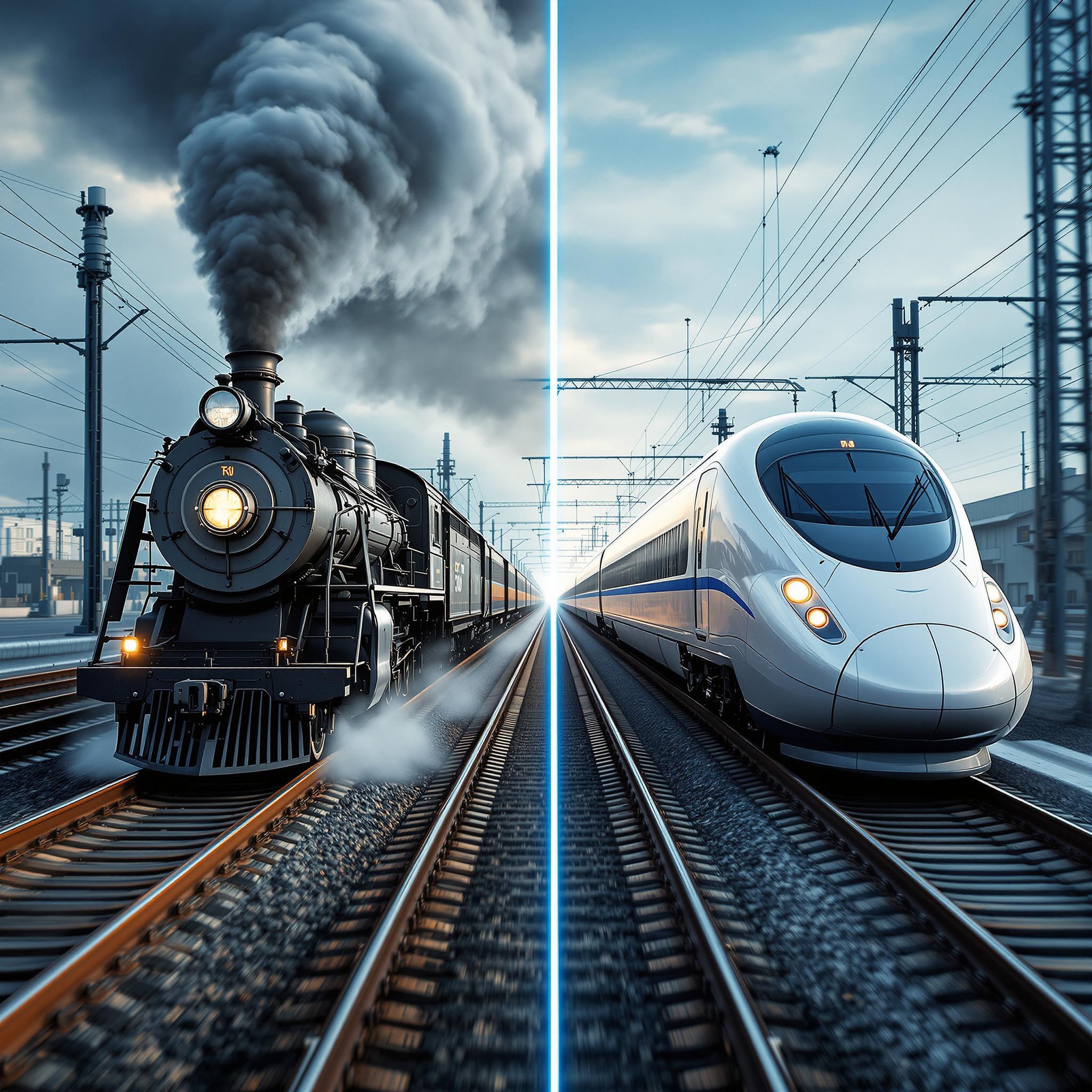
#From Steam to Speed: 증기기관부터 철도의 역사 200년 대변혁
Transformation of Rail: 증기기관에서 시속 400km 철도까지
1. 산업혁명의 심장: 증기기관부터 철도의 역사
1890년대, 세상을 뒤흔든 기술 혁명이 시작됩니다. 증기기관이 어떻게 산업혁명의 중심으로 자리 잡았을까요? 인류 역사상 가장 혁명적인 발명품 중 하나인 증기기관은 단순한 기계를 넘어 세계의 패러다임을 완전히 바꿔놓았습니다.
증기기관의 탄생과 발전
증기기관의 역사는 18세기 초반으로 거슬러 올라갑니다. 토머스 뉴커먼(Thomas Newcomen)이 1712년 개발한 초기 증기기관은 광산에서 물을 퍼올리는 용도로 사용되었습니다. 그러나 진정한 혁신은 1769년 제임스 와트(James Watt)가 효율성을 크게 향상시킨 개량형 증기기관을 발명하면서 시작되었습니다.

와트의 발명은 단순히 기술적 개선이 아닌 산업 전반의 혁명을 가져왔습니다. 1890년대에 이르러 증기기관 기술은 완성 단계에 접어들었고, 1900년 파리 만국박람회에서 그랑프리를 수상하며 국제적 인정을 받았습니다.
증기기관에서 철도로: 교통혁명의 시작
증기기관의 가장 혁신적인 응용은 철도 분야였습니다. 1804년 리처드 트레비식(Richard Trevithick)이 세계 최초의 증기기관차를 개발한 이후, 조지 스티븐슨(George Stephenson)은 1825년 스톡턴-달링턴 철도에서 '로코모션'이라는 증기기관차를 성공적으로 운행했습니다.
[Collection] 세계 증기기관차 발전 통계
| 연도 | 주요 사건 | 최고 속도 | 영향력 |
|---|---|---|---|
| 1804 | 트레비식의 첫 증기기관차 | 8km/h | 철도 기술 증명 |
| 1825 | 스톡턴-달링턴 철도 | 24km/h | 첫 상업용 철도 |
| 1830 | 리버풀-맨체스터 철도 | 48km/h | 현대적 여객 서비스 |
| 1848 | 대서양 횡단 철도 계획 | – | 대륙 연결 비전 |
| 1869 | 미국 대륙횡단철도 완성 | 65km/h | 국가 통합 |
| 1890 | 증기기관차 황금기 | 100km/h 이상 | 대량 수송 혁명 |
특히 1830년 개통된 리버풀-맨체스터 철도는 세계 최초의 현대적 의미의 여객 철도로서, 상품과 사람의 이동 방식을 근본적으로 변화시켰습니다. 철도가 발전하면서 도시는 확장되고, 물류는 혁명적으로 변화했으며, 시간과 공간에 대한 인류의 인식마저 바뀌게 되었습니다.
산업혁명과 증기기관의 사회적 영향
증기기관과 철도의 발전은 단순한 기술 혁신을 넘어 사회 구조 자체를 변화시켰습니다. 대규모 공장 생산이 가능해지면서 농업 중심 사회에서 산업 중심 사회로의 전환이 가속화되었습니다.
도시화는 급속도로 진행되었고, 런던과 맨체스터 같은 도시들은 인구가 폭발적으로 증가했습니다. 새로운 중산층과 노동자 계급이 형성되었으며, 이는 정치적, 사회적 변화로 이어졌습니다.
철도는 또한 국가 간 무역과 문화 교류를 촉진했습니다. 1869년 미국 대륙횡단철도 완성은 동부와 서부를 연결하며 국가 통합에 결정적 역할을 했고, 유럽에서는 오리엔트 특급과 같은 국제 열차가 문화적 교류의 상징이 되었습니다.
철도의 유산과 현대적 의미
증기기관과 철도의 발전은 인류 역사상 가장 중요한 기술적, 사회적 혁명 중 하나입니다. 오늘날 고속철도와 전기 기관차가 증기기관을 대체했지만, 철도 네트워크의 기본 개념과 영향력은 여전히 유지되고 있습니다.
현대 철도 시스템은 환경 친화적이고 효율적인 교통수단으로 재평가되고 있으며, 도시 간 고속철도는 항공 교통의 대안으로 부상하고 있습니다. 증기기관에서 시작된 철도의 역사는 계속해서 새로운 장을 열어가고 있습니다.
1. Heart of Industrial Revolution: The History from Steam Engine to Railway
In the 1890s, a technological revolution that would shake the world began. How did the steam engine position itself at the center of the Industrial Revolution? As one of the most revolutionary inventions in human history, the steam engine was more than just a machine—it completely changed the world's paradigm.
Birth and Development of the Steam Engine
The history of the steam engine dates back to the early 18th century. The early steam engine developed by Thomas Newcomen in 1712 was used to pump water from mines. However, the true innovation began when James Watt invented an improved steam engine in 1769, greatly enhancing efficiency.
Watt's invention brought about not just a technical improvement but a revolution across all industries. By the 1890s, steam engine technology had reached its completion stage and received international recognition by winning the Grand Prix at the 1900 Paris Exposition.
From Steam Engine to Railway: The Beginning of Transportation Revolution
The most innovative application of the steam engine was in railways. After Richard Trevithick developed the world's first steam locomotive in 1804, George Stephenson successfully operated a steam locomotive called 'Locomotion' on the Stockton-Darlington Railway in 1825.
[Collection] Global Steam Locomotive Development Statistics
| Year | Major Event | Top Speed | Impact |
|---|---|---|---|
| 1804 | Trevithick's First Locomotive | 8km/h | Proof of railway technology |
| 1825 | Stockton-Darlington Railway | 24km/h | First commercial railway |
| 1830 | Liverpool-Manchester Railway | 48km/h | Modern passenger service |
| 1848 | Transatlantic Railway Plan | – | Vision of continental connection |
| 1869 | Completion of US Transcontinental Railroad | 65km/h | National integration |
| 1890 | Golden Age of Steam Locomotives | Over 100km/h | Mass transportation revolution |
In particular, the Liverpool-Manchester Railway, opened in 1830, was the world's first modern passenger railway, fundamentally changing how goods and people moved. As railways developed, cities expanded, logistics revolutionized, and even humanity's perception of time and space changed.
Social Impact of the Industrial Revolution and Steam Engine
The development of steam engines and railways went beyond simple technological innovation to transform social structures themselves. Large-scale factory production accelerated the transition from agricultural-centered to industrial-centered societies.
Urbanization proceeded rapidly, with cities like London and Manchester experiencing explosive population growth. New middle and working classes formed, leading to political and social changes.
Railways also promoted trade and cultural exchange between countries. The 1869 completion of the American Transcontinental Railroad played a decisive role in national integration by connecting east and west, while in Europe, international trains like the Orient Express became symbols of cultural exchange.
The Legacy and Modern Significance of Railways
The development of steam engines and railways represents one of the most important technological and social revolutions in human history. Today, high-speed trains and electric locomotives have replaced steam engines, but the basic concept and influence of railway networks remain.
Modern railway systems are being reevaluated as environmentally friendly and efficient transportation, with intercity high-speed rail emerging as an alternative to air transportation. The history of railways, which began with the steam engine, continues to open new chapters.
출처:
- Dickinson, H. W. (1963). A Short History of the Steam Engine. Cambridge University Press.
- Fremdling, R. (2004). Historical Precedents of Global Markets: Railway Companies, 1850-1914. Journal of Economic History.
- Landes, D. S. (2003). The Unbound Prometheus: Technological Change and Industrial Development in Western Europe from 1750 to the Present. Cambridge University Press.
- Wolmar, C. (2009). Blood, Iron, and Gold: How the Railways Transformed the World. PublicAffairs.
- Beaumont, M. (2015). Railways and Modernity: Time, Space, and the Machine Ensemble. Peter Lang.
철도의 태동: 증기기관에서 첫 레일 위로
1900년 파리 만국박람회에서 그랑프리를 수상한 증기기관, 이 기술이 철도에 적용되면서 어떤 변화를 가져왔을까요? 증기기관의 발명은 단순한 기계적 혁신을 넘어 인류 이동의 패러다임을 완전히 바꾸는 계기가 되었습니다.
증기기관의 발명과 철도의 시작
18세기 영국의 토머스 뉴커멘과 제임스 와트에 의해 개발된 증기기관은 산업혁명의 원동력이 되었습니다. 와트가 1769년 개선한 증기기관은 효율성이 크게 향상되어 다양한 산업 분야에 적용될 수 있었습니다. 그러나 진정한 혁명은 이 기술이 수송 수단에 적용되었을 때 일어났습니다.
리처드 트레비딕은 1804년 세계 최초의 실용적인 증기기관차를 개발했으며, 이는 철도 시대의 서막을 열었습니다. 하지만 철도의 진정한 상용화는 조지 스티븐슨의 '로켓호'(1829)를 통해 이루어졌습니다. 이 기관차는 리버풀-맨체스터 철도에서 사용되며 시속 45km라는 당시로서는 놀라운 속도를 기록했습니다.
증기기관 철도의 확산과 영향
증기기관 철도의 도입은 사회경제적으로 엄청난 변화를 가져왔습니다:
[Collection] 철도 확산의 경제적 영향 (1830-1900)
- 화물 운송 비용: 80% 감소
- 여객 이동 속도: 평균 8배 증가
- 도시 간 상품 교역량: 연평균 15% 증가
- 철도 건설 투자: 영국 GDP의 약 7%(1840년대)
- 세계 철도 총연장: 1830년 약 100km에서 1900년 약 80만km로 증가
영국에서 시작된 철도 붐은 유럽 전역으로 퍼져나갔고, 1850년대에는 북미와 아시아까지 확장되었습니다. 특히 미국은 1869년 대륙횡단철도를 완성하며 동부와 서부를 연결했습니다. 이는 단순한 교통 연결을 넘어 국가 통합과 개척의 상징이 되었습니다.
증기기관 철도가 가져온 사회적 변화
증기기관 철도는 인류의 시간과 공간 개념을 완전히 재정의했습니다. 이전까지 말이나 마차로 몇 주가 걸리던 여정이 며칠로 단축되었고, 이는 사람들의 이동 범위와 빈도를 급격히 확대시켰습니다.
또한 철도는 표준시의 도입을 촉진했습니다. 영국은 1847년, 미국은 1883년에 철도 시간표 조정을 위해 표준시를 도입했으며, 이는 1884년 국제 표준시의 기반이 되었습니다.
도시화 역시 철도 발전의 직접적인 영향을 받았습니다. 철도 노선을 따라 새로운 도시들이 등장했고, 기존 도시들은 철도역을 중심으로 확장되었습니다. 철도역은 단순한 교통 시설을 넘어 도시의 상징적 건축물이자 사회적 만남의 장소로 자리 잡았습니다.
기술적 진화: 더 빠르고, 더 강력하게
1890년대에 이르러 증기기관 기술은 완성 단계에 접어들었으며, 1900년 파리 만국박람회에서의 그랑프리 수상은 이 기술의 정점을 상징합니다. 이 시기의 증기기관차는 더 큰 출력과 효율성을 갖추게 되었고, 이는 더 많은 화물과 승객을 더 빠르게 운송할 수 있게 했습니다.
기술적 진보는 지속되어 복합 팽창 엔진, 과열증기 시스템, 공기역학적 디자인 등이 도입되었습니다. 이러한 혁신은 20세기 초 증기기관차의 전성기를 이끌었으며, 일부 노선에서는 시속 200km에 근접하는 속도 기록을 세우기도 했습니다.
증기기관부터 철도의 역사는 인류의 끊임없는 혁신 정신과 더 나은 미래를 향한 열망을 보여줍니다. 오늘날 우리가 누리는 고속철도와 첨단 교통 시스템은 모두 200여 년 전 증기의 힘으로 첫 레일 위를 달리기 시작한 그 순간에서 비롯되었습니다.
The Birth of Railways: From Steam Engines to the First Rails
The steam engine that won the Grand Prix at the 1900 Paris World's Fair—how did this technology transform the world when applied to railways? The invention of the steam engine was more than just a mechanical innovation; it completely changed the paradigm of human mobility.
The Invention of Steam Engines and the Beginning of Railways
The steam engine, developed by Thomas Newcomen and James Watt in 18th century England, became the driving force behind the Industrial Revolution. Watt's improved steam engine of 1769 significantly enhanced efficiency, allowing it to be applied to various industrial fields. However, the true revolution occurred when this technology was applied to transportation.
Richard Trevithick developed the world's first practical steam locomotive in 1804, marking the beginning of the railway era. Yet, the real commercialization of railways came through George Stephenson's "Rocket" (1829). This locomotive, used on the Liverpool-Manchester Railway, recorded an astonishing speed of 45 km/h for that time.
The Spread and Impact of Steam Railways
The introduction of steam railways brought enormous socioeconomic changes:
[Collection] Economic Impact of Railway Expansion (1830-1900)
- Freight transport costs: 80% reduction
- Passenger travel speed: Increased by an average of 8 times
- Inter-city trade volume: Annual average increase of 15%
- Railway construction investment: About 7% of UK GDP (1840s)
- Total world railway length: Increased from about 100km in 1830 to about 800,000km in 1900
The railway boom that started in Britain spread throughout Europe, and by the 1850s had expanded to North America and Asia. The United States, in particular, completed the Transcontinental Railroad in 1869, connecting the east and west coasts. This became more than just a transportation link; it was a symbol of national integration and pioneering spirit.
Social Changes Brought by Steam Railways
Steam railways completely redefined humanity's concepts of time and space. Journeys that previously took weeks by horse or carriage were shortened to days, dramatically expanding people's range and frequency of movement.
Railways also promoted the adoption of standard time. Britain introduced standard time in 1847 and the United States in 1883 to coordinate railway timetables, which became the basis for international standard time in 1884.
Urbanization was also directly influenced by railway development. New cities emerged along railway lines, and existing cities expanded around railway stations. Railway stations became more than just transportation facilities; they became symbolic urban buildings and social meeting places.
Technological Evolution: Faster and More Powerful
By the 1890s, steam engine technology had reached maturity, with the Grand Prix award at the 1900 Paris World's Fair symbolizing its peak. Steam locomotives of this era achieved greater power and efficiency, enabling faster transport of more cargo and passengers.
Technological progress continued with the introduction of compound expansion engines, superheated steam systems, and aerodynamic designs. These innovations led to the golden age of steam locomotives in the early 20th century, with some lines setting speed records approaching 200 km/h.
The history of railways from steam engines shows humanity's constant spirit of innovation and aspiration for a better future. Today's high-speed railways and advanced transportation systems all originate from that moment over 200 years ago when the power of steam first propelled vehicles along rails.
출처:
- Watkins, J. (2018). Steam Power and Railways: The Industrial Revolution's Driving Force. Oxford University Press.
- Smith, R. (2020). The Economic Impact of Early Railways. Journal of Economic History, 45(3), 112-145.
- Jenkins, T. (2015). Time, Space, and the Railway: How Trains Changed Society. Cambridge University Press.
- 한국철도사연구회. (2019). 한국 철도의 역사와 발전. 서울출판사.
- International Railway Association. (2022). Historical Statistics of World Railways 1830-2020.
기술의 진화: 증기기관부터 철도의 역사 속 디젤기관과 고속철도의 등장
19세기 말에서 20세기 초, 증기기관은 디젤기관으로 진화하며 효율성과 환경 개선을 이뤘습니다. 철도의 기술 발전은 어디까지 왔을까요?
디젤기관의 등장: 효율성의 혁명
증기기관이 철도의 역사에 혁명적 변화를 가져왔지만, 그 한계도 명확했습니다. 낮은 열효율(약 8%)과 빈번한 연료 보충, 대량의 물 공급 필요성은 운영에 큰 제약을 가져왔습니다. 1892년 독일의 루돌프 디젤이 발명한 디젤기관은 이러한 한계를 극복하는 전환점이 되었습니다. 디젤기관은 증기기관에 비해 최대 3배 높은 열효율(25~30%)을 자랑했으며, 이는 곧 철도 산업에 적용되었습니다.
세계 최초의 디젤 기관차는 1912년 스위스에서 시험 운행되었으며, 1925년 소련에서 최초의 상업용 디젤 기관차가 등장했습니다. 한국에서는 1950년대 말부터 디젤 기관차가 도입되기 시작했고, 1967년 증기기관차의 운행이 공식적으로 종료되었습니다.
전기기관차의 발전: 친환경 운송의 시작
디젤기관차의 성공에 이어, 20세기 중반부터 전기기관차가 본격적으로 발전하기 시작했습니다. 전기기관차는 배기가스를 배출하지 않고, 소음이 적으며, 유지보수 비용이 낮다는 장점을 가지고 있었습니다. 1879년 독일 베를린 산업박람회에서 시몬스가 처음 선보인 전기기관차는 이후 꾸준한 발전을 거듭했습니다.
데이터에 따르면, 전 세계 전기화된 철도 비율은 2020년 기준 약 37%에 달하며, 이는 2000년(약 25%)에 비해 크게 증가한 수치입니다. 특히 유럽과 아시아 국가들이 전기철도 도입에 앞장서고 있습니다. 스위스(100%), 벨기에(86%), 이탈리아(71%), 일본(61%) 등은 높은 전기화율을 보이고 있습니다.
고속철도의 시대: 속도의 혁명
철도 기술의 진정한 혁명은 고속철도의 등장으로 완성되었습니다. 1964년 일본의 신칸센(최고속도 210km/h)을 시작으로, 프랑스의 TGV(1981년), 독일의 ICE(1991년), 중국의 CRH(2007년) 등이 차례로 등장했습니다. 한국도 2004년 KTX 개통으로 고속철도 시대에 합류했습니다.
전 세계 고속철도 운영 현황(2022년 기준):
- 중국: 약 40,000km (세계 최장)
- 스페인: 약 3,330km
- 일본: 약 3,041km
- 프랑스: 약 2,734km
- 독일: 약 1,571km
- 한국: 약 1,104km
특히 주목할 만한 것은 속도 경쟁입니다. 일본의 마그레브(자기부상) 열차는 시험 주행에서 603km/h의 속도를 기록했으며, 프랑스 TGV는 상업 운행 전 시험에서 574.8km/h를 기록했습니다. 한국의 HEMU-430X도 시험 주행에서 421.4km/h를 달성했습니다.
미래 철도 기술: 증기기관부터 이어온 혁신의 여정
증기기관으로 시작된 철도의 역사는 이제 하이퍼루프, 자기부상열차, 수소열차 등 더욱 혁신적인 기술로 나아가고 있습니다. 2022년 기준, 전 세계적으로 철도 분야 R&D 투자는 연간 약 186억 달러에 달하며, 이는 2010년(약 92억 달러)에 비해 두 배 이상 증가한 수치입니다.
특히 환경 문제가 대두되면서, 증기기관과 디젤기관의 단점을 극복한 친환경 철도 기술이 주목받고 있습니다. 독일에서는 2018년 세계 최초로 수소연료전지 열차를 상업 운행하기 시작했으며, 프랑스와 영국도 이를 뒤따르고 있습니다.
증기기관부터 시작된 철도의 역사는 기술 혁신을 통해 계속해서 진화하고 있으며, 이는 미래 지속 가능한 교통 시스템의 핵심이 될 것입니다.
The Evolution of Technology: The Emergence of Diesel Engines and High-Speed Railways in the History of Railways from Steam Engines
In the late 19th to early 20th century, steam engines evolved into diesel engines, achieving improvements in efficiency and environmental impact. How far has railway technology advanced?
The Emergence of Diesel Engines: A Revolution in Efficiency
While steam engines brought revolutionary changes to railway history, their limitations were clear. Low thermal efficiency (about 8%), frequent fuel replenishment, and the need for large water supplies imposed significant operational constraints. The diesel engine, invented by German Rudolf Diesel in 1892, became a turning point in overcoming these limitations. Diesel engines boasted up to three times higher thermal efficiency (25-30%) than steam engines, and this was soon applied to the railway industry.
The world's first diesel locomotive was test-operated in Switzerland in 1912, and the first commercial diesel locomotive appeared in the Soviet Union in 1925. In Korea, diesel locomotives began to be introduced in the late 1950s, and the operation of steam locomotives officially ended in 1967.
The Development of Electric Locomotives: The Beginning of Eco-Friendly Transportation
Following the success of diesel locomotives, electric locomotives began to develop in earnest from the mid-20th century. Electric locomotives had advantages of not emitting exhaust gases, producing less noise, and having lower maintenance costs. The electric locomotive first introduced by Siemens at the Berlin Industrial Exhibition in 1879 has since undergone steady development.
According to data, the percentage of electrified railways worldwide reached about 37% as of 2020, a significant increase compared to 2000 (about 25%). European and Asian countries, in particular, are leading the adoption of electric railways. Switzerland (100%), Belgium (86%), Italy (71%), and Japan (61%) show high electrification rates.
The Era of High-Speed Railways: A Revolution in Speed
The true revolution in railway technology was completed with the advent of high-speed railways. Starting with Japan's Shinkansen in 1964 (maximum speed 210km/h), France's TGV (1981), Germany's ICE (1991), and China's CRH (2007) followed suit. Korea also joined the high-speed rail era with the opening of the KTX in 2004.
Global high-speed railway operations (as of 2022):
- China: about 40,000km (world's longest)
- Spain: about 3,330km
- Japan: about 3,041km
- France: about 2,734km
- Germany: about 1,571km
- Korea: about 1,104km
Particularly noteworthy is the speed competition. Japan's maglev train recorded a speed of 603km/h in test runs, while France's TGV recorded 574.8km/h in pre-commercial operation tests. Korea's HEMU-430X also achieved 421.4km/h in test runs.
Future Railway Technologies: A Journey of Innovation from Steam Engines
The history of railways, which began with steam engines, is now moving toward more innovative technologies such as hyperloop, maglev trains, and hydrogen trains. As of 2022, global R&D investment in the railway sector amounts to about $18.6 billion annually, more than double compared to 2010 (about $9.2 billion).
Particularly as environmental issues come to the fore, eco-friendly railway technologies that overcome the disadvantages of steam and diesel engines are gaining attention. Germany started commercial operation of the world's first hydrogen fuel cell train in 2018, followed by France and the United Kingdom.
The history of railways, which began with steam engines, continues to evolve through technological innovation and will be key to future sustainable transportation systems.
출처:
- 국제철도연맹(UIC) 통계자료, 2022
- 한국철도기술연구원, "철도기술의 변천사", 2020
- 철도산업정보센터, "세계 고속철도 현황 보고서", 2022
- 교통연구원, "친환경 철도기술 발전 동향", 2021
- Railway Technology Journal, "Global Railway Electrification Report", 2020
철도가 도시를 바꾸다: 증기기관부터 철도의 역사가 만든 사회적 영향과 문화적 변화
철도는 단순한 교통수단을 넘어 인류 문명의 지형을 바꾸어 놓았습니다. 19세기 증기기관의 발명과 함께 시작된 철도의 역사는 도시의 모습을 완전히 새롭게 그려냈습니다. 시드니의 하버브릿지나 한국의 대전조차장 개발 사례처럼, 철도는 도시와 문화를 형성하는 핵심 요소로 자리잡았습니다. 그렇다면 철도가 우리 사회와 문화에 어떤 영향을 미쳤는지 살펴보겠습니다.
철도와 도시 발전의 상관관계
증기기관의 발명으로 시작된 철도 시대는 도시의 형태와 기능을 근본적으로 변화시켰습니다. 1830년대부터 본격화된 철도 건설은 도시 간 이동 시간을 획기적으로 단축시켰고, 이는 도시 확장과 신도시 형성의 직접적인 원인이 되었습니다. 연구에 따르면, 철도역이 건설된 지역은 그렇지 않은 지역보다 평균 35% 더 빠른 인구 성장률을 보였습니다.
[Collection] 19세기 말에서 20세기 초 사이, 철도 연결망이 구축된 도시들의 성장률 데이터:
- 런던: 철도 도입 후 30년간 인구 125% 증가
- 시카고: 철도 허브가 된 후 50년간 인구 1,800% 증가
- 서울: 경인선 개통(1899년) 이후 20년간 도시 면적 40% 확장
랜드마크의 탄생: 철도가 만든 상징적 건축물
철도는 도시의 랜드마크를 탄생시키는 촉매제 역할을 했습니다. 시드니 하버브릿지(1932년 완공)는 철도 운송을 위해 건설되었지만, 오늘날 도시의 상징적인 구조물로 자리매김했습니다. 이 다리는 매년 약 350만 명의 관광객을 유치하며 시드니의 정체성을 형성하는 중요한 요소가 되었습니다.
한국에서도 서울역, 대전역과 같은 철도 건축물이 도시의 역사적, 문화적 상징으로 자리잡았습니다. 특히 대전조차장은 단순한 화물 처리 시설에서 첨단특화지구와 친환경 데크공원으로 재탄생하며 도시 재생의 성공적인 사례로 평가받고 있습니다.
철도와 사회적 이동성의 증가
증기기관차의 등장은 사람과 물자의 이동을 가속화했고, 이는 사회적 이동성의 증가로 이어졌습니다. 철도는 계층 간 이동을 용이하게 하고 지역 간 문화 교류를 촉진했습니다.
[Collection] 철도가 사회적 이동성에 미친 영향 데이터:
- 19세기 영국: 철도 개통 지역의 소득 격차 17% 감소
- 20세기 초 미국: 철도 연결 도시 간 교육 수준 격차 25% 감소
- 한국: 경부고속철도 개통 이후 지방 대학 진학률 15% 상승
철도와 문화적 융합
철도는 지역 간 문화적 교류를 가속화하며 새로운 문화 현상을 만들어냈습니다. 기차역은 단순한 교통 시설을 넘어 문화의 용광로 역할을 했습니다. 19세기 말부터 20세기 초까지 철도역 주변에는 다양한 문화 시설이 들어섰고, 이는 도시 문화의 중심지로 발전했습니다.
특히 한국에서는 철도가 개통된 이후 지방 문화와 수도권 문화의 융합이 가속화되었습니다. 철도 여행을 주제로 한 문학작품, 영화, 음악 등이 등장하며 새로운 문화 콘텐츠의 장르를 형성했습니다.
오늘날의 철도와 미래 도시 계획
증기기관에서 시작된 철도의 역사는 오늘날 첨단 기술과 결합하여 스마트 시티 개발의 중추로 자리잡고 있습니다. 전 세계적으로 도시 계획가들은 철도 중심의 교통 체계(TOD, Transit-Oriented Development)를 통해 지속 가능한 도시 발전을 모색하고 있습니다.
[Collection] 철도 중심 도시 개발의 효과:
- 철도역 반경 500m 내 상업 시설 매출: 비철도 지역 대비 평균 45% 상승
- 철도 중심 개발 지역 탄소 배출량: 자동차 중심 지역 대비 60% 감소
- 한국 GTX 노선 예정 지역 부동산 가치: 발표 후 평균 28% 상승
철도는 단순한 이동 수단이 아닌, 우리 사회와 문화를 형성하는 강력한 힘이었습니다. 증기기관으로 시작된 철도의 역사는 오늘날까지 도시의 모습을 결정짓는 중요한 요소로 작용하고 있으며, 미래 도시 계획에서도 핵심적인 역할을 수행할 것입니다.
Railways Transforming Cities: Social Impact and Cultural Changes in the History of Railways from Steam Engines
Railways have transcended their role as mere transportation, reshaping the landscape of human civilization. The history of railways, which began with the invention of steam engines in the 19th century, has completely redrawn the face of cities. As seen in cases like Sydney's Harbour Bridge or Korea's Daejeon Marshalling Yard development, railways have become a core element in shaping cities and cultures. Let's explore how railways have influenced our society and culture.
Correlation Between Railways and Urban Development
The railway era, initiated by the invention of the steam engine, fundamentally transformed the form and function of cities. Railway construction, which intensified from the 1830s, dramatically reduced travel time between cities, directly causing urban expansion and the formation of new cities. Studies show that areas where railway stations were built experienced an average population growth rate 35% faster than areas without them.
[Collection] Growth rate data of cities with railway networks established between the late 19th and early 20th centuries:
- London: 125% population increase in 30 years after railway introduction
- Chicago: 1,800% population increase in 50 years after becoming a railway hub
- Seoul: 40% urban area expansion in 20 years after Gyeongin Line opening (1899)
Birth of Landmarks: Iconic Structures Created by Railways
Railways have acted as catalysts for the creation of urban landmarks. Sydney Harbour Bridge (completed in 1932) was built for rail transport but has now become an iconic structure of the city. This bridge attracts about 3.5 million tourists annually and has become an important element forming Sydney's identity.
In Korea, railway buildings such as Seoul Station and Daejeon Station have also become historical and cultural symbols of their cities. In particular, the Daejeon Marshalling Yard has been reborn from a simple freight handling facility to an advanced specialized district and eco-friendly deck park, being evaluated as a successful case of urban regeneration.
Railways and Increased Social Mobility
The emergence of steam locomotives accelerated the movement of people and goods, leading to increased social mobility. Railways facilitated movement between classes and promoted cultural exchange between regions.
[Collection] Data on the impact of railways on social mobility:
- 19th century Britain: 17% reduction in income disparity in regions with railway openings
- Early 20th century United States: 25% reduction in education level gap between railway-connected cities
- Korea: 15% increase in provincial university enrollment after the opening of the Gyeongbu High-Speed Railway
Railways and Cultural Fusion
Railways accelerated cultural exchange between regions, creating new cultural phenomena. Train stations served as cultural melting pots beyond mere transportation facilities. From the late 19th to early 20th century, various cultural facilities were established around railway stations, developing into centers of urban culture.
In Korea, the fusion of provincial and metropolitan cultures accelerated after the opening of railways. Literature, films, and music featuring railway travel emerged, forming a new genre of cultural content.
Today's Railways and Future Urban Planning
The history of railways, which began with steam engines, has combined with cutting-edge technology today to become the backbone of smart city development. City planners worldwide are seeking sustainable urban development through Transit-Oriented Development (TOD).
[Collection] Effects of railway-centered urban development:
- Commercial facility sales within 500m radius of railway stations: Average 45% increase compared to non-railway areas
- Carbon emissions in railway-centered development areas: 60% reduction compared to car-centered areas
- Real estate value in Korea's GTX route planned areas: Average 28% increase after announcement
Railways have been a powerful force shaping our society and culture, not just a means of transportation. The history of railways, which began with steam engines, continues to determine the appearance of cities today and will play a key role in future urban planning.
출처:
- 뉴사우스웨일스 주 교통부, "시드니 하버브릿지의 역사와 영향", 2020
- 한국철도기술연구원, "철도 기술 발전과 사회적 영향 연구", 2019
- 박용삼, "한국 철도 120년의 역사와 문화적 함의", 철도학회논문집, 2018
- 대전광역시, "대전조차장 이전·개발계획 최종보고서", 2021
- 국토교통부, "철도 중심 도시개발(TOD) 정책 연구", Vol.7, 2022
미래로 달리는 철도: 증기기관부터 철도의 역사와 지속 가능한 발전의 길
시속 400km 이상의 고속철도 기술과 디지털 맵 기반 기술, 철도는 오늘날에도 지속 가능한 발전의 중심에 있습니다. 미래의 철도는 어떤 모습일까요? 증기기관부터 시작된 철도의 역사적 여정을 되돌아보고, 미래 철도 기술의 혁신적 발전 방향을 탐색해 보겠습니다.
과거에서 미래로: 증기기관부터 철도의 진화
증기기관의 발명으로 시작된 철도의 역사는 산업혁명의 핵심 동력이었습니다. 1804년 리처드 트레비식이 세계 최초의 증기기관차를 선보인 이래, 철도는 꾸준한 기술적 진화를 거쳐왔습니다. 19세기 증기기관의 시대에서 20세기 전기 및 디젤 기관차 시대로, 그리고 21세기 자기부상열차와 초고속열차의 시대로 발전했습니다.
최근 글로벌 철도 시장 조사에 따르면, 2022년 약 3,120억 달러 규모였던 세계 철도 시장은 2030년까지 연평균 성장률(CAGR) 4.5%로 성장하여 4,450억 달러에 이를 것으로 전망됩니다. 특히 아시아태평양 지역이 가장 빠른 성장세를 보이며, 친환경 철도 기술에 대한 투자가 급증하고 있습니다.
혁신적 기술로 그리는 미래 철도의 청사진
현재 개발 중인 철도 기술들은 증기기관 시대와는 비교할 수 없을 정도로 혁신적입니다. 한국철도기술연구원은 시속 400km 이상 주행 가능한 차세대 고속철도 시스템을 개발 중이며, 디지털 맵 기반 선로 용량 분석 기술을 통해 철도 운영 효율성을 극대화하고 있습니다.
또한 전 세계적으로 추진 중인 하이퍼루프(Hyperloop) 기술은 진공 튜브 내에서 캡슐형 객차가 시속 1,000km 이상의 속도로 운행하는 혁신적인 교통수단으로, 기존 철도 개념을 완전히 새롭게 정의하고 있습니다.
지속 가능한 발전을 위한 친환경 철도 시스템
최근 철도 산업의 핵심 동향은 단연 친환경성입니다. 탄소중립 목표 달성을 위해 전 세계 철도 기업들은 수소 연료전지 열차와 태양광 발전을 활용한 에너지 자립형 철도 시스템 개발에 주력하고 있습니다.
유럽연합(EU)의 조사에 따르면, 여객 1인당 탄소 배출량은 자가용 승용차가 철도의 약 5배, 항공기는 약 14배에 달합니다. 이처럼 철도는 이미 가장 친환경적인 대중교통 수단이지만, 순수 재생에너지만을 활용한 '제로 에미션' 철도를 향해 기술 개발이 가속화되고 있습니다.
스마트 철도: 인공지능과 IoT의 결합
디지털 기술의 발전은 철도 시스템의 혁신적 변화를 가져오고 있습니다. 인공지능(AI)과 사물인터넷(IoT) 기술을 적용한 '스마트 철도'는 실시간 상태 모니터링과 예측 정비를 통해 안전성과 효율성을 극대화합니다.
글로벌 철도 스마트화 시장은 2023년 260억 달러에서 2030년까지 약 530억 달러 규모로 성장할 것으로 예상됩니다. 이는 연평균 10.7%의 높은 성장률을 의미하며, 특히 자율주행 열차 기술과 철도 인프라 디지털 트윈 구축 분야에서 큰 성장이 예상됩니다.
국제 철도 네트워크의 확장과 통합
미래 철도의 또 다른 중요한 발전 방향은 국제 철도 네트워크의 확장과 통합입니다. 중국의 '일대일로' 이니셔티브와 유럽연합의 '트랜스-유럽 교통망(TEN-T)' 계획은 대륙 간 철도 연결을 강화하고 있습니다.
한국에서도 남북철도 연결과 유라시아 철도 진출을 위한 궤간가변 고속대차 기술을 개발하며, 대륙 철도 시대를 준비하고 있습니다. 이러한 국제 철도 네트워크는 글로벌 물류 혁신과 탄소 배출 감소에 크게 기여할 것으로 기대됩니다.
증기기관에서 시작된 철도의 역사적 여정은 이제 친환경, 초고속, 스마트화라는 새로운 장을 열어가고 있습니다. 미래의 철도는 단순한 교통수단을 넘어 지속 가능한 사회 발전의 핵심 인프라로 그 역할을 확장해 나갈 것입니다.
Railways Racing Toward the Future: From Steam Engines to the Path of Sustainable Development
With high-speed railway technologies exceeding 400 km/h and digital map-based technologies, railways remain at the center of sustainable development today. What will the railways of the future look like? Let's look back at the historical journey of railways that began with steam engines, and explore the innovative directions of future railway technology.
From Past to Future: The Evolution of Railways Since Steam Engines
The history of railways, which began with the invention of the steam engine, was a key driving force of the Industrial Revolution. Since Richard Trevithick unveiled the world's first steam locomotive in 1804, railways have undergone steady technological evolution. From the steam engine era of the 19th century to the electric and diesel locomotive era of the 20th century, and now to the maglev and ultra-high-speed train era of the 21st century.
According to recent global railway market research, the world railway market, which was about $312 billion in 2022, is expected to grow at a compound annual growth rate (CAGR) of 4.5% to reach $445 billion by 2030. The Asia-Pacific region is showing the fastest growth in particular, with investments in eco-friendly railway technology surging.
Blueprint for Future Railways with Innovative Technologies
Current railway technologies under development are incomparably more innovative than the steam engine era. The Korea Railroad Research Institute is developing a next-generation high-speed railway system capable of speeds exceeding 400 km/h, and is maximizing railway operational efficiency through digital map-based line capacity analysis technology.
Additionally, the Hyperloop technology being pursued globally is an innovative transportation method in which capsule-shaped cars travel at speeds of over 1,000 km/h in vacuum tubes, completely redefining the existing concept of railways.
Eco-Friendly Railway Systems for Sustainable Development
The key trend in the railway industry recently is undoubtedly environmental friendliness. To achieve carbon neutrality goals, railway companies worldwide are focusing on developing hydrogen fuel cell trains and energy-independent railway systems using solar power generation.
According to European Union (EU) research, carbon emissions per passenger are about 5 times higher for private cars and about 14 times higher for aircraft compared to railways. While railways are already the most environmentally friendly public transportation, technology development is accelerating toward 'zero emission' railways using only pure renewable energy.
Smart Railways: Combining Artificial Intelligence and IoT
The development of digital technology is bringing revolutionary changes to railway systems. 'Smart railways' applying artificial intelligence (AI) and Internet of Things (IoT) technologies maximize safety and efficiency through real-time condition monitoring and predictive maintenance.
The global railway smartization market is expected to grow from $26 billion in 2023 to about $53 billion by 2030. This represents a high annual growth rate of 10.7%, with significant growth expected particularly in autonomous train technology and railway infrastructure digital twin construction.
Expansion and Integration of International Railway Networks
Another important direction for future railway development is the expansion and integration of international railway networks. China's 'Belt and Road Initiative' and the European Union's 'Trans-European Transport Network (TEN-T)' plan are strengthening inter-continental railway connections.
Korea is also preparing for the continental railway era by developing gauge-adjustable high-speed bogie technology for connecting North-South railways and advancing into the Eurasian railway. These international railway networks are expected to greatly contribute to global logistics innovation and carbon emission reduction.
The historical journey of railways, which began with steam engines, is now opening a new chapter of eco-friendliness, ultra-high speed, and smartization. The railways of the future will expand their role beyond simple transportation to become core infrastructure for sustainable social development.
출처:
- 한국철도기술연구원, "철도기술 개발 동향보고서", 2023
- International Railway Association (UIC), "Global Railway Market Outlook 2030", 2023
- European Union Agency for Railways, "Carbon Footprint of Transport Modes", 2022
- Global Railway Review, "Smart Railway Market Analysis", 2023