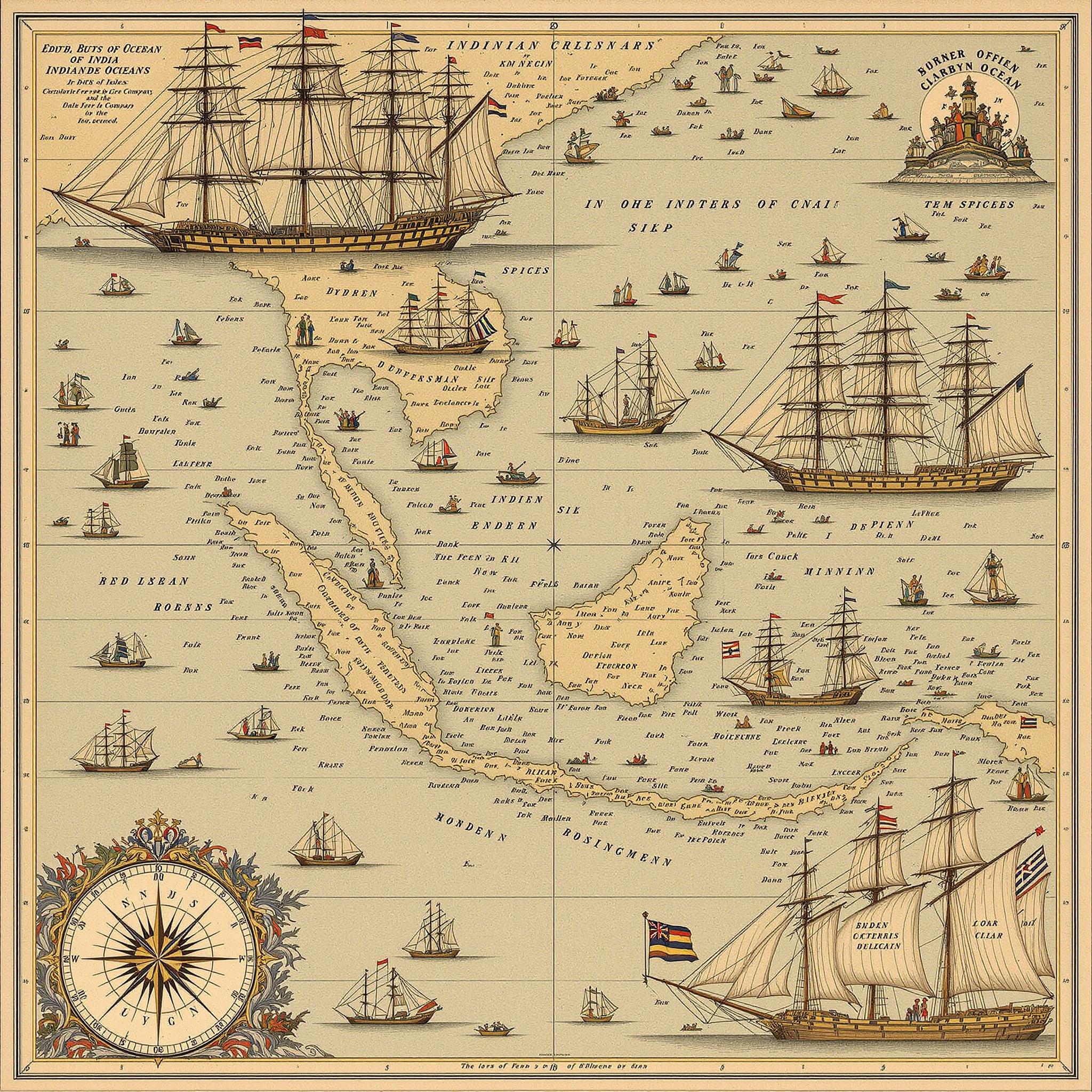
#1600년대 유럽의 경제 제국 동인도회사 세계무역 장악하다
East India Companies Dominate Global Trade in 1600s Economic Empire
1. 17세기, 세계 경제의 판도를 바꾼 두 거대 기업의 등장
1600년대 초, 두 회사가 유럽의 아시아 진출을 주도하며 세계 경제의 중심으로 떠오릅니다. 영국 동인도회사(EIC)와 네덜란드 동인도회사(VOC), 이들의 시작은 어떻게 이루어졌을까요?
1600년대 경제를 지배한 두 무역 거인의 탄생
17세기 초, 유럽의 경제 지형도를 완전히 바꿔놓은 두 거대 기업이 등장했습니다. 바로 **영국 동인도회사(EIC)**와 **네덜란드 동인도회사(VOC)**입니다. 이 두 회사는 단순한 무역 회사를 넘어 국가와 맞먹는 권력을 행사하며 세계 경제의 새로운 질서를 만들어냈습니다.
영국 동인도회사는 1600년 엘리자베스 1세의 칙허장을 받아 설립되었고, 네덜란드 동인도회사는 그보다 2년 후인 1602년에 여섯 개의 작은 무역회사들이 통합되어 탄생했습니다. 특히 VOC는 세계 최초의 주식회사 형태로 설립되어 경제사적으로도 큰 의미를 가집니다.
아시아 향신료와 사치품을 향한 치열한 경쟁

1600년대 영국과 네덜란드의 동인도회사는 아시아의 값비싼 향신료, 비단, 도자기 등을 유럽으로 가져오는 독점 무역권을 갖고 있었습니다. 이 시기 세계 무역 데이터를 살펴보면 놀라운 사실이 드러납니다:
[Collection] 1650년대 VOC와 EIC의 무역량 비교
- VOC 연간 무역액: 약 270만 길더 (현재 가치 약 1,900억 원)
- EIC 연간 무역액: 약 200만 파운드 (현재 가치 약 1,500억 원)
- 아시아-유럽 무역의 약 75%를 두 회사가 장악
- VOC 배당금: 연평균 18% (당시 일반 투자 수익의 3배)
이러한 엄청난 무역량은 유럽 내 물가와 소비 패턴을 완전히 바꿔놓았습니다. 특히 향신료 가격은 이전의 1/10 수준으로 하락하며 일반 시민들도 접근할 수 있게 되었습니다.
최초의 글로벌 기업, 경제 시스템의 변혁을 이끌다
두 동인도회사는 단순히 물건을 사고파는 것을 넘어 무역 기반 시설과 금융 시스템을 혁신했습니다. 암스테르담과 런던에 설립된 증권거래소는 이들 회사의 주식을 거래하기 위해 발전했으며, 무역 보험, 해상법, 국제 금융 시스템의 기초가 이 시기에 만들어졌습니다.
영국 동인도회사는 인도 지역을 중심으로, 네덜란드 동인도회사는 동남아시아 지역을 장악하며 상호 경쟁과 때로는 무력 충돌도 불사했습니다. 1623년 암보이나 학살 사건은 이러한 경쟁이 얼마나 치열했는지를 보여주는 역사적 사례입니다.
17세기 이 두 기업의 등장은 현대 글로벌 경제 시스템의 원형을 만들어냈다고 해도 과언이 아닙니다. 국경을 넘어선 무역, 다국적 기업의 운영, 주식을 통한 자본 조달 등 오늘날 당연하게 여겨지는 경제 활동의 기초가 이 시기에 확립되었습니다.
1. The Rise of Two Giant Companies That Changed the World Economy in the 17th Century
In the early 1600s, two companies led Europe's expansion into Asia and emerged as centers of the world economy. How did the British East India Company (EIC) and the Dutch East India Company (VOC) begin their journey?
The Birth of Two Trading Giants Dominating the 1600s Economy
In the early 17th century, two massive enterprises emerged that completely transformed Europe's economic landscape. These were the British East India Company (EIC) and the Dutch East India Company (VOC). These two companies were more than mere trading entities; they wielded power comparable to nations and created a new world economic order.
The British East India Company was established in 1600 with a royal charter from Queen Elizabeth I, while the Dutch East India Company was formed two years later in 1602 through the consolidation of six smaller trading companies. Notably, the VOC was established as the world's first joint-stock company, giving it significant historical economic importance.
Fierce Competition for Asian Spices and Luxury Goods
In the 1600s, the British and Dutch East India Companies held monopoly rights to bring expensive spices, silk, porcelain, and other goods from Asia to Europe. Examining world trade data from this period reveals astonishing facts:
[Collection] Comparison of VOC and EIC Trade Volumes in the 1650s
- VOC annual trade value: approximately 2.7 million guilders (about 190 billion won in current value)
- EIC annual trade value: approximately 2 million pounds (about 150 billion won in current value)
- The two companies controlled about 75% of Asia-Europe trade
- VOC dividends: 18% annual average (three times the return on typical investments of the time)
This tremendous trade volume completely transformed prices and consumption patterns within Europe. Spice prices, in particular, fell to about 1/10 of their previous levels, making them accessible to ordinary citizens.
The First Global Corporations, Leading Economic System Transformation
The two East India Companies did more than simply buy and sell goods; they innovated trading infrastructure and financial systems. Stock exchanges established in Amsterdam and London evolved to trade these companies' shares, and trade insurance, maritime law, and international financial systems were developed during this period.
The British East India Company focused on the Indian region, while the Dutch East India Company dominated Southeast Asia, engaging in mutual competition and sometimes even armed conflicts. The Amboyna Massacre of 1623 is a historical example of how intense this competition became.
The emergence of these two corporations in the 17th century created the prototype of the modern global economic system. Cross-border trade, multinational corporate operations, and capital raising through stocks – economic activities that are taken for granted today were established during this period.
출처:
- Furber, H. (1976). Rival Empires of Trade in the Orient, 1600-1800. University of Minnesota Press.
- Chaudhuri, K. N. (1978). The Trading World of Asia and the English East India Company: 1660-1760. Cambridge University Press.
- Gaastra, F. S. (2003). The Dutch East India Company: Expansion and Decline. Walburg Pers.
설립과 초기 활동: 1600년대 영국과 네덜란드 동인도회사의 서로 다른 전략
영국과 네덜란드, 두 나라는 각자의 방식으로 동인도회사를 설립했습니다. 세계 최초의 주식회사 VOC와 왕실 특허 기반의 EIC, 그들의 초기 전략은 무엇이었을까요?
두 강대국의 동인도회사 설립 배경
1600년대 초반, 유럽의 두 해상 강국은 아시아 무역을 장악하기 위한 야심찬 계획을 실행에 옮겼습니다. 영국 동인도회사(EIC) 는 1600년 12월 31일 엘리자베스 1세의 칙허장을 받아 설립되었으며, 네덜란드 동인도회사(VOC) 는 이보다 2년 후인 1602년 3월 20일에 네덜란드 연방의회로부터 특허를 받아 출범했습니다.
두 회사의 설립 방식에는 분명한 차이가 있었습니다:
| 구분 | 영국 동인도회사(EIC) | 네덜란드 동인도회사(VOC) |
|---|---|---|
| 설립 형태 | 왕실 독점 특허 | 6개 지역 상공회의소 통합 |
| 초기 자본 | 72,000파운드 | 650만 길더(약 3백만 파운드) |
| 지배 구조 | 총독과 이사회 | 17인 이사회(Heeren XVII) |
| 투자 방식 | 원정별 출자 | 영구적 자본 투자 |
[Collection] 특히 주목할 점은 VOC의 혁신적인 자본 조달 방식입니다. 네덜란드 동인도회사는 1,800명의 투자자로부터 모금한 초기 자본금 650만 길더를 바탕으로 근대적 주식회사의 모델을 창출했습니다. 투자자들은 회사 운영에 직접 관여하지 않고도 배당을 받을 수 있었으며, 암스테르담 증권거래소에서 자유롭게 주식을 매매할 수 있었습니다. 반면 EIC는 초기에 원정별로 자본을 모집하는 방식을 취했으며, 1657년에 이르러서야 영구적 자본 구조로 전환했습니다.
초기 무역 전략과 지역적 확장
두 회사는 설립 초기부터 뚜렷한 전략적 차이를 보였습니다:
영국 동인도회사의 접근법
- 외교적 진출: 무굴 제국과의 관계 구축에 주력
- 교역소(Factory) 중심: 수라트(1612), 마드라스(1639), 봄베이(1668), 캘커타(1690) 설립
- 상업적 이익 중시: 초기에는 군사적 확장보다 무역 이익 추구
네덜란드 동인도회사의 접근법
- 공격적 독점 추구: 향신료 섬에 대한 배타적 통제권 확보
- 요새와 거점 확보: 바타비아(현 자카르타, 1619) 건설을 시작으로 군사적 요충지 확보
- 현지 생산 체계 구축: 향신료 생산지에 대한 직접 관리 체계 도입
[Collection] 1620년대까지 두 회사의 초기 무역량을 비교해보면, VOC가 더 빠른 성장세를 보였습니다. 1620년 기준 VOC는 연간 50척 이상의 상선을 아시아에 파견했으며, 유럽으로 귀환하는 선박의 화물 가치는 약 300만 길더에 달했습니다. 같은 시기 EIC는 연간 15척 내외의 선박을 운영했으며, 교역 규모는 VOC의 1/3 수준이었습니다.
경쟁과 갈등: 향신료 제도를 둘러싼 쟁탈전
두 회사의 경쟁은 특히 인도네시아 군도의 향신료 생산지에서 치열하게 전개되었습니다. 1623년 암보이나 학살 사건은 이러한 갈등의 절정이었습니다. 네덜란드인들은 영국 상인들이 현지인과 음모를 꾸몄다는 혐의로 10명의 영국 상인을 고문하고 처형했습니다.
이 사건 이후 EIC는 인도네시아 지역에서 철수하고 인도 대륙에 집중하는 전략적 결정을 내렸습니다. 이는 결과적으로 두 회사의 영향권을 분리하는 계기가 되었습니다:
- VOC: 동남아시아 군도와 스리랑카 중심
- EIC: 인도 아대륙 중심
[Collection] 1625년부터 1650년 사이 VOC는 향신료 무역에서 연평균 18%의 수익률을 기록했으며, EIC는 인도 면직물과 완제품 교역에서 13-15%의 수익률을 달성했습니다. 향신료 교역은 수익성이 높았지만 변동성도 컸던 반면, 직물 교역은 상대적으로 안정적인 수익구조를 가졌습니다.
1600년대 동인도회사의 경제적 영향
두 동인도회사는 초기 전략의 차이에도 불구하고 세계 경제 질서에 유사한 영향을 미쳤습니다:
- 아시아-유럽 교역로 재편: 전통적인 중동 경유 육상 교역로를 해상 루트로 대체
- 상품 유통 혁신: 장거리 해상 교역의 효율성 증대
- 소비 문화 변화: 차, 향신료, 도자기 등 아시아 상품의 유럽 내 대중화
- 금융 시스템 발전: 해상 보험, 선하증권, 국제 결제 시스템 발전
[Collection] 1650년경 네덜란드 동인도회사의 선단은 150척이 넘는 대형 상선과 40여 척의 무장 호위함을 보유했으며, 동아시아에 근무하는 직원 수는 약 1만 명에 달했습니다. 영국 동인도회사는 같은 시기 약 30-40척의 상선과 3,000여 명의 인력을 운용했으나, 세기 말에는 그 규모가 두 배 이상 확대되었습니다.
1600년대 영국과 네덜란드 동인도회사의 서로 다른 설립 방식과 초기 전략은 향후 두 세기 동안 세계 경제의 흐름을 결정짓는 중요한 요소가 되었습니다. 이들이 구축한 교역 네트워크와 경영 시스템은 오늘날 글로벌 기업의 원형이 되었으며, 세계화의 첫 장을 열었다고 볼 수 있습니다.
Establishment and Early Activities: Different Strategies of British and Dutch East India Companies in the 1600s
England and the Netherlands each established East India Companies in their own way. What were the early strategies of the VOC, the world's first joint-stock company, and the EIC, based on royal charter?
The Establishment Background of Two Maritime Powers
In the early 1600s, Europe's two naval powers implemented ambitious plans to dominate Asian trade. The British East India Company (EIC) was established on December 31, 1600, with a royal charter from Queen Elizabeth I, while the Dutch East India Company (VOC) was launched on March 20, 1602, receiving a charter from the Dutch Federal Parliament, two years later.
There were clear differences in how the two companies were established:
| Category | British East India Company (EIC) | Dutch East India Company (VOC) |
|---|---|---|
| Form of Establishment | Royal Monopoly Charter | Integration of 6 Regional Chambers of Commerce |
| Initial Capital | 72,000 pounds | 6.5 million guilders (approx. 3 million pounds) |
| Governance Structure | Governor and Board of Directors | Board of 17 Directors (Heeren XVII) |
| Investment Method | Voyage-based funding | Permanent capital investment |
[Collection] Particularly noteworthy is the VOC's innovative capital raising method. The Dutch East India Company created a model for modern joint-stock companies based on initial capital of 6.5 million guilders raised from 1,800 investors. Investors could receive dividends without direct involvement in company operations and freely trade shares on the Amsterdam Stock Exchange. In contrast, the EIC initially raised capital for each expedition separately and only switched to a permanent capital structure in 1657.
Early Trade Strategies and Territorial Expansion
The two companies showed distinct strategic differences from their inception:
British East India Company's Approach
- Diplomatic Entry: Focus on building relationships with the Mughal Empire
- Factory-Centered: Establishment of Surat (1612), Madras (1639), Bombay (1668), Calcutta (1690)
- Commercial Profit Priority: Initially pursued trade profits rather than military expansion
Dutch East India Company's Approach
- Aggressive Monopoly Pursuit: Securing exclusive control of spice islands
- Fortress and Stronghold Acquisition: Building military strongholds starting with Batavia (now Jakarta, 1619)
- Local Production System: Introduction of direct management systems for spice-producing regions
[Collection] Comparing the early trade volumes of the two companies until the 1620s, the VOC showed faster growth. As of 1620, the VOC dispatched more than 50 merchant ships annually to Asia, with the value of cargo returning to Europe reaching about 3 million guilders. During the same period, the EIC operated around 15 ships annually, with a trade volume of about 1/3 that of the VOC.
Competition and Conflict: The Struggle for the Spice Islands
Competition between the two companies was particularly fierce in the spice-producing regions of the Indonesian archipelago. The Amboyna Massacre of 1623 was the culmination of this conflict. The Dutch tortured and executed 10 English merchants on charges of conspiring with locals.
After this incident, the EIC made a strategic decision to withdraw from Indonesia and focus on the Indian subcontinent. This eventually served to separate the spheres of influence of the two companies:
- VOC: Centered on Southeast Asian archipelago and Sri Lanka
- EIC: Focused on the Indian subcontinent
[Collection] Between 1625 and 1650, the VOC recorded an average annual return of 18% in the spice trade, while the EIC achieved a 13-15% return in Indian textile and finished product trade. The spice trade was highly profitable but volatile, while the textile trade had a relatively stable profit structure.
Economic Impact of East India Companies in the 1600s
Despite differences in their early strategies, the two East India Companies had similar effects on the world economic order:
- Restructuring Asia-Europe Trade Routes: Replacing traditional Middle Eastern land routes with maritime routes
- Trade Distribution Innovation: Increasing efficiency of long-distance maritime trade
- Changes in Consumer Culture: Popularization of Asian products such as tea, spices, and porcelain in Europe
- Financial System Development: Development of maritime insurance, bills of lading, and international payment systems
[Collection] By 1650, the Dutch East India Company's fleet consisted of over 150 large merchant ships and about 40 armed escort ships, with approximately 10,000 employees working in East Asia. The British East India Company operated about 30-40 merchant ships and 3,000 personnel during the same period, but by the end of the century, its scale had more than doubled.
The different establishment methods and early strategies of the British and Dutch East India Companies in the 1600s became important factors determining the flow of the world economy for the next two centuries. The trade networks and management systems they built became the prototype for today's global corporations and opened the first chapter of globalization.
출처:
- Furber, H. (1976). Rival Empires of Trade in the Orient, 1600-1800. University of Minnesota Press.
- Keay, J. (1991). The Honourable Company: A History of the English East India Company. HarperCollins.
- Gaastra, F.S. (2003). The Dutch East India Company: Expansion and Decline. Walburg Pers.
경제적 영향력 확장: 1600년대 영국과 네덜란드 동인도회사의 무역 독점과 금융 혁신
향신료와 면직물, 차와 도자기. 두 회사는 각자의 주력 품목을 통해 경제적 영향력을 확대했습니다. 그들의 무역 독점과 금융 혁신은 어떻게 이루어졌을까요?
무역 독점의 경제적 파급력
1600년대 영국과 네덜란드의 동인도회사는 단순한 무역 기업을 넘어 경제 제국이었습니다. 두 회사는 동일한 목표를 가졌지만, 그 접근법과 전략에는 뚜렷한 차이가 있었습니다.
네덜란드 VOC의 독점 전략:
- 향신료 무역에 집중하여 1620년대까지 세계 정향 시장의 약 67%를 장악
- 자바와 수마트라에 집중적인 플랜테이션을 개발하여 공급망 수직계열화
- 현지 통치자들과의 계약을 통해 독점 공급권 확보
영국 EIC의 시장 개척:
- 면직물과 차 무역에 집중하며 중국과 인도 시장 개발
- 1664년 영국 내 차 수입량은 약 2.2파운드였으나 1700년 20,000파운드로 급증
- 뱅갈 지역 면직물 생산지 통제로 원자재 확보 및 유럽 시장 독점
이러한 무역 독점은 유럽 내 상품 가격을 크게 변동시켰습니다. 1600년대 초 암스테르담에서 후추 가격은 이전 세기 대비 75%까지 하락했으나, 두 회사의 독점 체제 구축 후 안정화되었습니다.
금융 혁신과 자본 조달
동인도회사의 가장 큰 공헌 중 하나는 자본주의 금융 시스템 발전이었습니다.
네덜란드 VOC의 금융 혁신:
- 세계 최초의 상장회사로서 주식 발행 (1602년 초기 자본금 6.5백만 길더)
- 주주에게 배당금 지급 시스템 도입 (평균 연 18% 수익률)
- 암스테르담 증권거래소를 통한 주식 거래 활성화
영국 EIC의 자본 조달:
- 모험 자본(Venture Capital)의 초기 형태 도입
- 1657년 영구적 주식회사로 전환하며 자본 안정화
- 런던 금융시장과의 연계로 장기 프로젝트 투자 확대

화폐 시스템과 국제 금융 네트워크
두 회사는 국제 화폐 시스템에도 큰 영향을 미쳤습니다. 특히 네덜란드 VOC는 일본 은과 동남아시아 향신료를 연결하는 무역 네트워크를 구축했으며, 영국 EIC는 인도 루피와 중국 은 시장을 연결했습니다.
데이터로 보는 동인도회사의 경제 규모:
- 1650년 VOC 선박 수: 연간 약 50척 운항
- 1670년 EIC 무역량: 약 35만 파운드 규모
- 1695년 두 회사의 아시아 교역액: 유럽 총 교역의 약 40% 차지
이들의 무역 네트워크는 단순한 상품 교역을 넘어, 국제 금융 시스템의 근간을 형성했습니다. 환어음과 신용장의 발달, 해상보험의 표준화, 그리고 무역 금융의 발전은 모두 두 동인도회사의 경제적 영향력 확장 과정에서 발전한 것들입니다.
Economic Influence Expansion: Trade Monopoly and Financial Innovation of British and Dutch East India Companies in the 1600s
Spices and cotton, tea and porcelain. Both companies expanded their economic influence through their flagship products. How did their trade monopolies and financial innovations come about?
Economic Impact of Trade Monopolies
In the 1600s, the British and Dutch East India Companies were more than mere trading enterprises; they were economic empires. While both companies shared similar goals, their approaches and strategies differed significantly.
Dutch VOC Monopoly Strategy:
- Focused on the spice trade, controlling about 67% of the world's clove market by the 1620s
- Developed intensive plantations in Java and Sumatra to vertically integrate supply chains
- Secured exclusive supply rights through contracts with local rulers
British EIC Market Development:
- Concentrated on cotton textiles and tea trade, developing markets in China and India
- Tea imports to England increased from about 2.2 pounds in 1664 to 20,000 pounds by 1700
- Controlled Bengal textile production areas to secure raw materials and monopolize European markets
These trade monopolies significantly affected product prices in Europe. In early 1600s Amsterdam, pepper prices had fallen by up to 75% compared to the previous century, but stabilized after the two companies established their monopoly systems.
Financial Innovation and Capital Raising
One of the greatest contributions of the East India Companies was the development of capitalist financial systems.
Dutch VOC Financial Innovations:
- World's first publicly traded company, issuing stocks (initial capital of 6.5 million guilders in 1602)
- Introduction of dividend payment systems to shareholders (average annual return of 18%)
- Promotion of stock trading through the Amsterdam Stock Exchange
British EIC Capital Raising:
- Introduction of early forms of venture capital
- Transition to a permanent joint-stock company in 1657, stabilizing capital
- Expansion of long-term project investments through connections with London financial markets
Monetary Systems and International Financial Networks
Both companies greatly influenced international monetary systems. The Dutch VOC built trading networks connecting Japanese silver with Southeast Asian spices, while the British EIC connected Indian rupee and Chinese silver markets.
East India Companies' Economic Scale in Data:
- VOC ship count in 1650: approximately 50 vessels operating annually
- EIC trade volume in 1670: approximately 350,000 pounds
- Asian trade value of both companies in 1695: about 40% of total European trade
Their trading networks went beyond simple commodity exchange to form the foundation of the international financial system. The development of bills of exchange and letters of credit, standardization of marine insurance, and the evolution of trade finance all developed during the economic expansion of these two East India Companies.
출처:
- Chaudhuri, K.N. (1978). The Trading World of Asia and the English East India Company: 1660-1760. Cambridge University Press.
- Gelderblom, O., & Jonker, J. (2004). Completing a Financial Revolution: The Finance of the Dutch East India Trade and the Rise of the Amsterdam Capital Market, 1595-1612. The Journal of Economic History, 64(3), 641-672.
- Tracy, J.D. (1991). The Political Economy of Merchant Empires. Cambridge University Press.
격렬한 경쟁과 1600년대 영국-네덜란드 동인도회사가 이끈 글로벌 경제의 변화
암보이나 학살사건부터 유럽 섬유산업 구조 변경까지, 두 회사의 경쟁은 단순한 상업적 다툼을 넘어 세계 경제의 변화를 이끌었습니다. 그들의 경쟁은 어떤 결과를 낳았을까요?
피의 경쟁, 무역 영토 분할로 이어지다
1623년 인도네시아 암보이나에서 발생한 사건은 두 동인도회사 간의 경쟁이 얼마나 치열했는지를 보여주는 결정적 사례입니다. 네덜란드인들이 영국 상인 10명과 일본인 상인들을 음모 혐의로 처형한 이 사건은 아시아 무역 패턴을 완전히 재편했습니다. 영국 동인도회사(EIC)는 향신료가 풍부한 인도네시아에서 철수하고 인도 대륙에 집중하게 되었으며, 네덜란드 동인도회사(VOC)는 동남아시아 군도에서 독점적 지위를 확보했습니다.
무역 패턴의 변화와 경제적 영향
영국과 네덜란드 동인도회사의 경쟁은 글로벌 무역 패턴을 근본적으로 변화시켰습니다:
-
인도 면직물 시장 확대: EIC가 인도에서 수입한 고품질 면직물(캘리코, 친츠)은 유럽 시장을 장악했습니다. 1670년대에는 연간 20만 피스 이상이 수입되었으며, 1700년대 초에는 100만 피스를 초과했습니다.
-
향신료 가격 혁명: VOC의 향신료 독점으로 유럽 내 향신료 가격은 안정되었으나, 아시아 현지에서는 생산자에게 낮은 가격을 강제했습니다. 1650년까지 네덜란드는 유럽 내 후추 시장의 약 57%를 통제했습니다.
-
새로운 소비 문화 탄생: 두 회사의 무역은 차, 커피, 도자기와 같은 동양 상품을 유럽에 소개했습니다. 특히 VOC가 자바에서 대규모로 재배한 커피는 유럽의 카페 문화를 탄생시켰습니다.
금융 혁신과 자본주의 발전
두 동인도회사는 근대 자본주의 발전에 중요한 역할을 했습니다:
| 금융 혁신 | 영국 동인도회사(EIC) | 네덜란드 동인도회사(VOC) |
|---|---|---|
| 주식 거래 | 개인 투자자 중심 | 세계 최초의 상장 주식회사 |
| 자본 조달 | 항해별 자본 모집 → 영구적 자본으로 전환 | 지속적 투자와 재투자 모델 |
| 배당금 | 불규칙적 지급, 현물 지급도 병행 | 정기적 배당금 지급(평균 18%) |
| 파생 금융 | 선물 거래 발전 | 옵션 계약 도입 |
특히 VOC 주식은 암스테르담 거래소에서 활발히 거래되어 세계 최초의 주식 거래 붐을 일으켰으며, 1650년대 VOC 주식 가치는 초기 가치의 약 450%까지 상승했습니다.
산업 구조의 변화와 보호무역주의 등장
두 회사의 활동은 유럽 내 산업 구조에도 큰 변화를 가져왔습니다:
-
섬유산업 재편: 인도산 면직물의 대량 수입으로 영국과 네덜란드의 전통적 섬유 제조업자들은 위기에 처했습니다. 이는 1700년대 초 영국에서 인도 직물 수입을 제한하는 캘리코 법안 제정으로 이어졌습니다.
-
국내 산업 보호정책: 동인도 무역의 부정적 영향을 막기 위해 유럽 각국은 보호무역 정책을 도입했으며, 이는 후기 중상주의 경제 체제를 강화했습니다.
-
기술 이전과 혁신: 동양의 직물, 도자기 제조 기술을 모방하려는 시도는 유럽 내 새로운 제조 기술 발전을 촉진했습니다.
결국 영국과 네덜란드 동인도회사의 경쟁은 단순한 무역 다툼을 넘어, 초기 글로벌 경제의 구조와 흐름을 형성한 결정적 요인이었습니다. 그들이 개척한 무역로와 경제 시스템은 오늘날 글로벌 경제의 근간이 되었습니다.
Competition and Global Economic Changes Led by British and Dutch East India Companies in the 1600s
From the Amboyna Massacre to the restructuring of the European textile industry, the competition between the two companies went beyond mere commercial rivalry to drive changes in the global economy. What were the consequences of their competition?
Bloody Competition Leading to Trade Territory Division
The incident in Amboyna, Indonesia in 1623 showcases how fierce the competition between the two East India Companies was. The Dutch execution of 10 English merchants and Japanese traders on conspiracy charges completely reshaped Asian trade patterns. The British East India Company (EIC) withdrew from spice-rich Indonesia to focus on the Indian subcontinent, while the Dutch East India Company (VOC) secured a monopolistic position in the Southeast Asian archipelago.
Changes in Trade Patterns and Economic Impact
The competition between the British and Dutch East India Companies fundamentally altered global trade patterns:
-
Expansion of Indian Textile Market: High-quality cotton textiles (calico, chintz) imported by the EIC from India dominated European markets. In the 1670s, over 200,000 pieces were imported annually, exceeding 1 million pieces by the early 1700s.
-
Spice Price Revolution: While VOC's spice monopoly stabilized prices in Europe, it forced low prices on producers in Asia. By 1650, the Netherlands controlled approximately 57% of the European pepper market.
-
Birth of New Consumer Culture: Trade by both companies introduced Eastern goods like tea, coffee, and porcelain to Europe. Coffee, particularly cultivated on a large scale by the VOC in Java, gave birth to Europe's café culture.
Financial Innovation and Capitalist Development
Both East India Companies played crucial roles in the development of modern capitalism:
| Financial Innovation | British East India Company (EIC) | Dutch East India Company (VOC) |
|---|---|---|
| Stock Trading | Focused on individual investors | World's first publicly listed company |
| Capital Raising | Per-voyage capital fundraising → Permanent capital | Continuous investment and reinvestment model |
| Dividends | Irregular payments, sometimes in kind | Regular dividend payments (18% average) |
| Derivative Finance | Development of futures trading | Introduction of options contracts |
VOC shares were actively traded on the Amsterdam Exchange, creating the world's first stock trading boom, with VOC share values rising to approximately 450% of their initial value by the 1650s.
Changes in Industrial Structure and the Emergence of Protectionism
The activities of both companies brought significant changes to Europe's industrial structure:
-
Textile Industry Restructuring: Mass imports of Indian cotton textiles threatened traditional textile manufacturers in Britain and the Netherlands. This led to the Calico Acts in Britain in the early 1700s, restricting Indian textile imports.
-
Domestic Industry Protection Policies: European countries introduced protectionist policies to counter the negative impacts of East India trade, strengthening the late mercantilist economic system.
-
Technology Transfer and Innovation: Attempts to imitate Eastern textile and porcelain manufacturing techniques stimulated the development of new manufacturing technologies in Europe.
Ultimately, the competition between the British and Dutch East India Companies was more than a trade rivalry; it was a decisive factor in shaping the structure and flow of the early global economy. The trade routes and economic systems they pioneered formed the foundation of today's global economy.
출처:
- Prakash, O. (2014). The Dutch East India Company and the Economy of Bengal. Princeton University Press.
- Robins, N. (2012). The Corporation That Changed the World: How the East India Company Shaped the Modern Multinational. Pluto Press.
- Gelderblom, O., & Jonker, J. (2004). "Completing a Financial Revolution: The Finance of the Dutch East India Trade and the Rise of the Amsterdam Capital Market, 1595-1612." The Journal of Economic History, 64(3), 641-672.
- Chaudhuri, K. N. (1978). The Trading World of Asia and the English East India Company: 1660-1760. Cambridge University Press.
5. 유산과 영향: 1600년대 동인도회사가 남긴 현대 경제의 초석
해상 보험제도와 선적 화물 담보 대출, 이 모든 것이 두 회사의 활동에서 시작되었습니다. 17세기 영국과 네덜란드 동인도회사는 단순한 무역회사를 넘어 오늘날 글로벌 경제 시스템의 기반을 마련했습니다. 그들이 남긴 유산은 현대 경제에 어떤 영향을 미쳤을까요?
금융 혁신의 시작: 자본시장과 현대 금융의 기원
1600년대 동인도회사들은 대규모 자본이 필요한 원거리 무역을 위해 혁신적인 금융 시스템을 개발했습니다. 특히 네덜란드 동인도회사(VOC)는 세계 최초의 주식회사로서 암스테르담 증권거래소에 상장되어 일반 대중으로부터 자본을 모았습니다. 연구에 따르면, VOC 주식의 최초 발행액은 당시 기준으로 약 640만 길더(현재 가치로 약 1억 달러)에 달했으며, 이는 당시 네덜란드 GDP의 약 8%에 해당하는 엄청난 규모였습니다.
[Collection] 주목할만한 금융 혁신 데이터:
- VOC 최초 주식 발행(1602): 640만 길더 (현재 가치 약 1억 달러)
- 연평균 배당률(1630-1650): 18%
- 영국 동인도회사(EIC) 최초 증자(1613): 41만 8천 파운드 (현재 가치 약 8천만 달러)
- 해상 보험 계약 건수(1680년대): 연간 약 4,000건
기업 거버넌스와 조직 구조의 혁명
두 동인도회사는 현대 기업의 조직 구조와 운영 방식의 원형을 제시했습니다. 주주총회, 이사회, 경영진으로 이어지는 의사결정 체계는 오늘날 기업 지배구조의 기본 틀이 되었습니다. 영국 동인도회사는 '코트 오브 디렉터스(Court of Directors)'라는 이사회를 통해 주주들의 이익을 대변하는 구조를 확립했으며, 이는 현대 이사회 시스템의 원형이 되었습니다.
글로벌 공급망과 국제 무역 네트워크
1600년대 동인도회사들은 최초의 진정한 글로벌 공급망을 구축했습니다. 아시아에서 유럽으로 향하는 무역로를 따라 중계무역 거점을 전략적으로 설치하고, 상품의 유통과 보관을 체계화했습니다.
[Collection] 동인도회사 무역 네트워크 규모:
- 영국 동인도회사 보유 선박(1680): 약 30척
- 네덜란드 동인도회사 보유 선박(1670): 약 150척
- 연간 향신료 유럽 수입량(1650): 약 700만 파운드
- 무역 거점 수(1680년대): 영국 15개, 네덜란드 25개
회계와 기록 유지의 표준화
두 회사는 복잡한 국제 거래를 관리하기 위해 회계 시스템을 발전시켰습니다. 특히 네덜란드 동인도회사의 복식부기 시스템은 당시로서는 혁신적이었으며, 오늘날 기업 회계의 기초가 되었습니다. EIC와 VOC는 모두 정기적인 재무보고서를 주주들에게 제공했으며, 이는 현대 기업의 정보 공개 관행의 선구자적 사례였습니다.
기업의 사회적 책임과 윤리적 교훈
현대 비즈니스 윤리에서 동인도회사의 유산은 양면적입니다. 한편으로는 혁신적인 경제 체계를 구축했지만, 다른 한편으로는 식민지 착취와 무역 독점을 통해 불평등한 경제 구조를 만들어냈습니다. 이는 현대 기업들에게 경제적 성공과 사회적 책임 사이의 균형을 찾아야 한다는 중요한 교훈을 제공합니다.
결론: 현대 경제로의 전환점
1600년대 영국과 네덜란드의 동인도회사는 단순한 무역 기업을 넘어 현대 경제 시스템의 초석을 놓았습니다. 주식회사 제도, 금융 상품 개발, 글로벌 공급망 구축, 기업 거버넌스 시스템 등 오늘날 우리가 당연하게 여기는 많은 경제적 구조와 관행이 이 두 거대 기업의 실험에서 비롯되었습니다. 역사적 관점에서 볼 때, 동인도회사의 운영 방식과 혁신은 자본주의 경제의 발전 과정에서 결정적인 전환점이었으며, 그 영향력은 오늘날까지 이어지고 있습니다.
5. Legacy and Impact: The Foundation of Modern Economy Built by the East India Companies of the 1600s
Maritime insurance systems and cargo collateral loans, all these began with the activities of these two companies. The 17th century British and Dutch East India Companies were more than just trading companies; they laid the groundwork for today's global economic system. What impact did their legacy have on the modern economy?
The Beginning of Financial Innovation: The Origin of Capital Markets and Modern Finance
In the 1600s, the East India Companies developed innovative financial systems for long-distance trade requiring massive capital. Notably, the Dutch East India Company (VOC), as the world's first joint-stock company, was listed on the Amsterdam Stock Exchange, raising capital from the general public. According to research, the initial issuance of VOC shares amounted to approximately 6.4 million guilders (about $100 million in today's value), which was about 8% of the Dutch GDP at that time—an enormous scale.
[Collection] Notable Financial Innovation Data:
- VOC Initial Stock Issuance (1602): 6.4 million guilders (approximately $100 million in current value)
- Average Annual Dividend Rate (1630-1650): 18%
- British East India Company (EIC) Initial Capital Increase (1613): 418,000 pounds (approximately $80 million in current value)
- Number of Maritime Insurance Contracts (1680s): About 4,000 annually
Revolution in Corporate Governance and Organizational Structure
The two East India Companies presented the prototype of modern corporate organizational structures and operational methods. The decision-making system flowing from shareholders' meetings to the board of directors to management became the basic framework of today's corporate governance. The British East India Company established a structure representing shareholders' interests through its "Court of Directors," which became the prototype of the modern board system.
Global Supply Chains and International Trade Networks
In the 1600s, the East India Companies built the first true global supply chains. They strategically established trade relay points along routes from Asia to Europe and systematized the distribution and storage of goods.
[Collection] Scale of East India Company Trade Networks:
- British East India Company Ships (1680): About 30 vessels
- Dutch East India Company Ships (1670): About 150 vessels
- Annual Spice Imports to Europe (1650): About 7 million pounds
- Number of Trading Posts (1680s): Britain 15, Netherlands 25
Standardization of Accounting and Record Keeping
Both companies developed accounting systems to manage complex international transactions. The double-entry bookkeeping system of the Dutch East India Company was particularly innovative for its time and became the foundation of modern corporate accounting. Both EIC and VOC provided regular financial reports to their shareholders, pioneering the information disclosure practices of modern corporations.
Corporate Social Responsibility and Ethical Lessons
The legacy of the East India Companies in modern business ethics is two-sided. On one hand, they built innovative economic systems; on the other, they created unequal economic structures through colonial exploitation and trade monopolies. This provides an important lesson for modern corporations about finding balance between economic success and social responsibility.
Conclusion: A Turning Point Toward Modern Economy
The British and Dutch East India Companies of the 1600s were more than just trading enterprises; they laid the cornerstone of the modern economic system. Many economic structures and practices we take for granted today—joint-stock company systems, financial product development, global supply chain construction, corporate governance systems—originated from these two giant corporations' experiments. From a historical perspective, the operating methods and innovations of the East India Companies were a decisive turning point in the development of the capitalist economy, and their influence continues to this day.
참고 문헌:
- Adams, J. (2019). Global Trade and Colonial Power: The East India Companies. Oxford University Press.
- Robins, N. (2017). The Corporation That Changed the World: How the East India Company Shaped the Modern Multinational. Pluto Press.
- Gelderblom, O., & Jonker, J. (2004). "Completing a Financial Revolution." The Journal of Economic History, 64(3), 641-672.